

Cyber-Resilient Bayesian Healthcare Surveillance Framework.
CRBHSF
Cyber-Resilient Bayesian Healthcare Surveillance Framework
CRBHSF provides a comprehensive framework for prospective healthcare performance surveillance through the integration of Bayesian risk estimation, latent organisational trust modelling, cyber-resilience assessment, decision-theoretic optimisation, and digital-twin deployment simulation.
The package was developed to support uncertainty-aware healthcare surveillance and proactive operational risk management in complex, digitally dependent healthcare systems.
Highlights
- Bayesian healthcare surveillance
- Cyber-resilience risk assessment
- Latent organisational trust modelling
- Prospective deterioration prediction
- External validation framework
- Ablation and incremental-value analysis
- Decision-theoretic intervention prioritisation
- Digital-twin deployment simulation
- Publication-quality visualisations
- Reproducible healthcare analytics workflows
Framework Overview

The CRBHSF workflow integrates healthcare performance data, Bayesian surveillance modelling, organisational trust estimation, cyber-resilience assessment, risk stratification, intervention prioritisation, and digital-twin deployment evaluation within a unified analytical framework.
Why CRBHSF?
Traditional healthcare monitoring systems primarily identify performance issues after they occur. CRBHSF extends conventional surveillance by integrating:
- Bayesian uncertainty quantification
- Prospective deterioration monitoring
- Latent organisational trust estimation
- Cyber-resilience risk assessment
- External validation workflows
- Ablation and incremental-value analysis
- Decision-theoretic intervention prioritisation
- Capacity-constrained deployment simulation
- Digital-twin operational evaluation
Installation
install.packages("remotes")

remotes::install_github("zerish12/CRBHSF")
Core Workflow
library(CRBHSF)

df <- clean_health_data(
  data,
  provider_col = "provider",
  time_col = "month"
)

df <- fit_bayesian_surveillance(
  df,
  y_col = "y",
  n_col = "n"
)

df <- estimate_latent_trust(
  df,
  anomaly_col = "anomaly",
  corruption_col = "corruption",
  cyber_col = "cyber",
  missing_col = "missing"
)

df <- compute_crbhsf_risk(df)

df <- compute_crpr(df)

df <- create_deterioration_outcome(
  df,
  provider_col = "provider",
  time_col = "month",
  value_col = "risk_crbhsf",
  threshold = 0.04
)

validation_results <- validate_surveillance(
  df,
  outcome_col = "future_deterioration",
  score_col = "risk_crbhsf"
)

validation_results
Example Outputs
Cyber-Resilient Risk Distribution
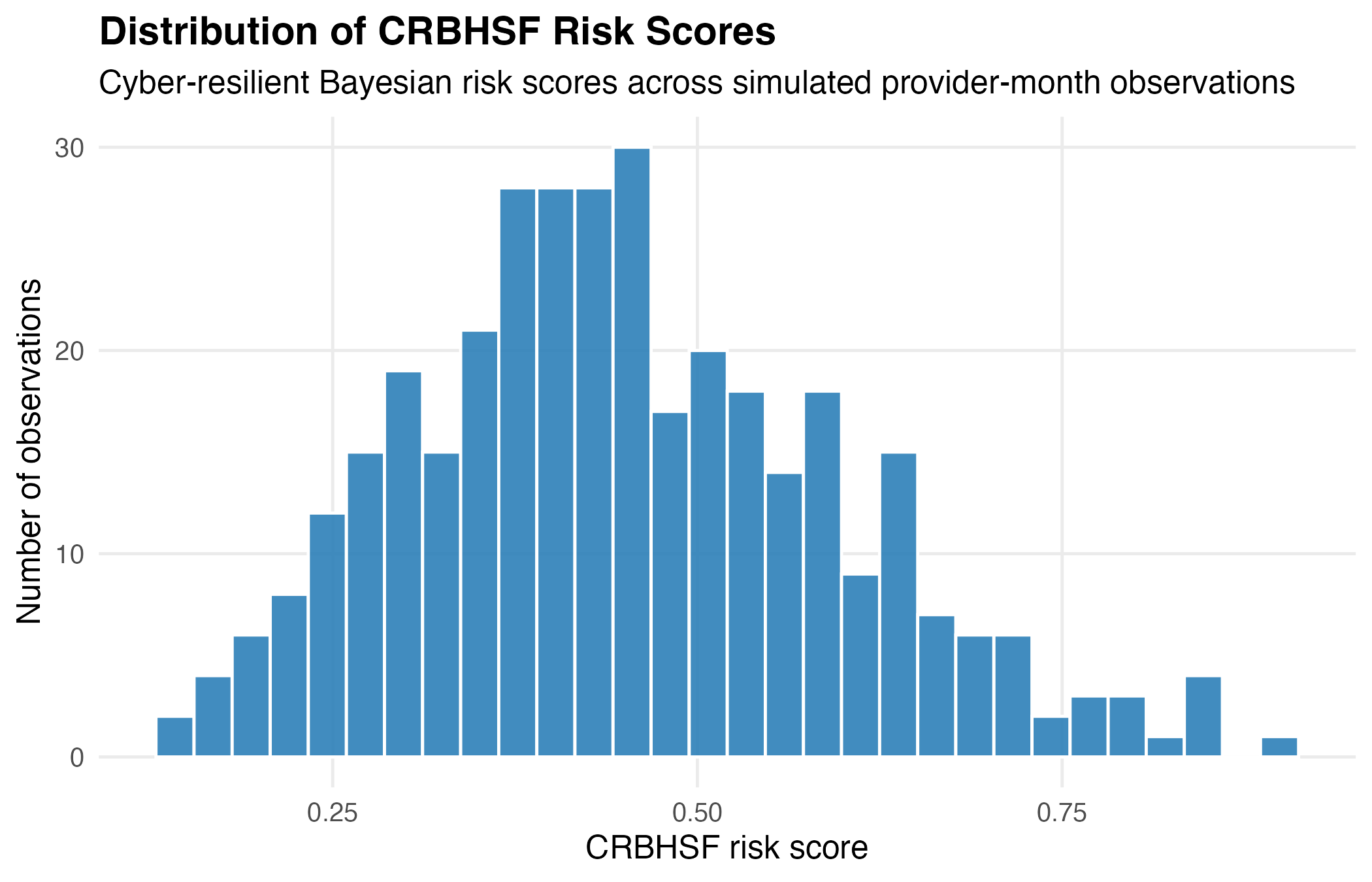
Distribution of cyber-resilient Bayesian surveillance risk scores across healthcare providers.
Incremental Predictive Value of Framework Components
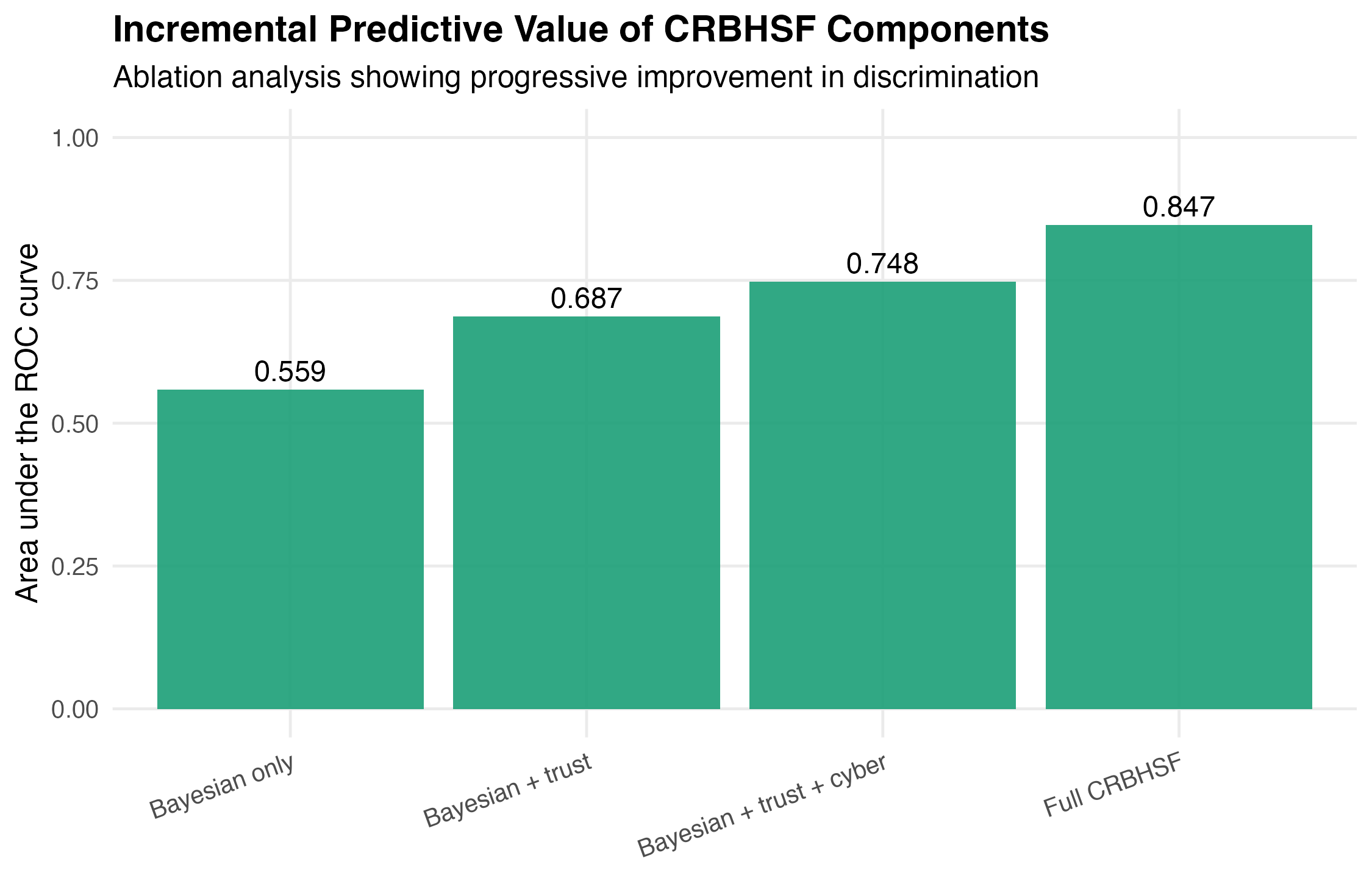
Ablation analysis illustrating the incremental contribution of Bayesian surveillance, latent trust modelling, and cyber-resilience assessment.
Digital-Twin Deployment Impact
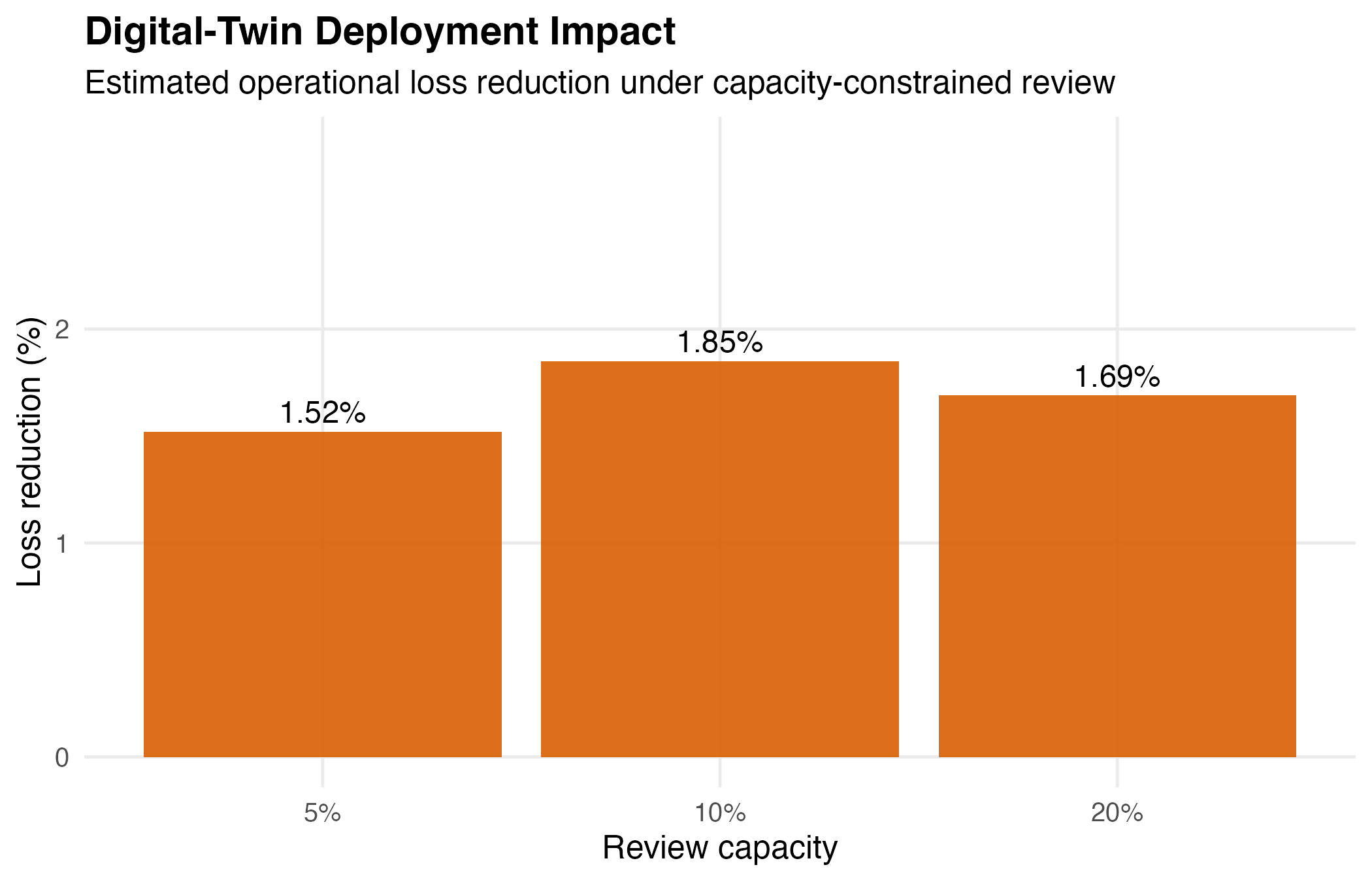
Estimated reduction in operational losses under alternative intervention-capacity scenarios.
Main Functions
| Function | Purpose |
|---|---|
clean_health_data() | Healthcare data cleaning and preparation |
create_deterioration_outcome() | Future deterioration outcome generation |
fit_bayesian_surveillance() | Bayesian surveillance modelling |
estimate_latent_trust() | Organisational trust estimation |
compute_crbhsf_risk() | Cyber-resilient Bayesian risk computation |
compute_crpr() | Cyber-Resilience Pressure Ratio |
validate_surveillance() | Model validation and performance assessment |
run_ablation_study() | Incremental-value evaluation |
compare_ml_benchmarks() | Machine-learning benchmark comparison |
estimate_evib() | Expected intervention benefit estimation |
simulate_digital_twin() | Digital-twin deployment simulation |
plot_risk_distribution() | Risk visualisation |
plot_ablation_auc() | Ablation-analysis visualisation |
plot_deployment_impact() | Deployment-impact visualisation |
generate_surveillance_report() | Automated surveillance reporting |
Research Applications
CRBHSF is designed for:
- Healthcare performance surveillance
- NHS operational analytics
- Hospital performance monitoring
- Cyber-resilience assessment
- Health system resilience research
- Bayesian healthcare analytics
- Operational risk prediction
- Digital-twin deployment studies
- Decision-theoretic intervention planning
- Healthcare operations research
Methodological Foundations
The framework draws upon contemporary developments in:
- Bayesian healthcare surveillance
- Clinical prediction model development
- External validation methodology
- Decision-analytic model evaluation
- Cyber-resilience assessment
- Digital-twin healthcare simulation
Key references include:
- Efthimiou O, Seo M, Chalkou K, et al. (2024). Developing clinical prediction models: A step-by-step guide. BMJ.
- Collins GS, Moons KGM, Dhiman P, et al. (2024). TRIPOD+AI Statement. BMJ.
- Vickers AJ, Elkin EB (2006). Decision curve analysis: A novel method for evaluating prediction models. Medical Decision Making.
Package Status
Current version: 0.1.0
Status: Active development
Platform: R
License: MIT
Citation
If you use CRBHSF in research, please cite:
Khan MZ, Khan AW (2026).
CRBHSF: Cyber-Resilient Bayesian Healthcare Surveillance Framework.
R package version 0.1.0.
Authors
Muhammad Zahir Khan
Independent Researcher in Health Data Science and Statistical Methodology, United Kingdom
Email: [email protected]
Abdul Wahid Khan
BS Cyber Security Student
Email: [email protected]
Future Development
Planned extensions include:
- Fully Bayesian hierarchical trust estimation
- Real-time healthcare surveillance dashboards
- Advanced cyber-threat integration
- Interactive digital-twin environments
- NHS performance monitoring applications
- Shiny-based deployment tools
Project Vision
CRBHSF aims to advance healthcare surveillance beyond conventional retrospective monitoring by integrating uncertainty quantification, cyber resilience, organisational trust, operational risk assessment, and deployment-oriented decision support within a unified analytical framework. The package is intended to support researchers, healthcare organisations, policy analysts, and operational decision-makers seeking proactive and resilience-aware performance management strategies.
License
MIT License.