

Functions for Stochastic Search Variable Selection (SSVS).
SSVS 

The goal of {SSVS} is to provide functions for performing stochastic search variable selection (SSVS) for binary and continuous outcomes and visualizing the results. SSVS is a Bayesian variable selection method used to estimate the probability that individual predictors should be included in a regression model. Using MCMC estimation, the method samples thousands of regression models in order to characterize the model uncertainty regarding both the predictor set and the regression parameters.
Installation
You can install the development version of {SSVS} from GitHub with:
# install.packages("remotes")
remotes::install_github("sabainter/SSVS")
Example 1 - continuous response variable
Consider a simple example using SSVS on the mtcars dataset to predict quarter mile times. We first specify our response variable (“qsec”), then choose our predictors and run the ssvs() function.
library(SSVS)
outcome <- 'qsec'
predictors <- c('cyl', 'disp', 'hp', 'drat', 'wt',
 'vs', 'am', 'gear', 'carb','mpg')

results <- ssvs(data = mtcars, x = predictors, y = outcome, progress = FALSE)
The results can be summarized and printed using the summary() function. This will display both the MIP for each predictor, as well as the probable range of values for each coefficient.
summary_results <- summary(results, interval = 0.9, ordered = TRUE)
| Variable | MIP | Avg Beta | Lower CI (90%) | Upper CI (90%) | Avg Nonzero Beta |
|---|---|---|---|---|---|
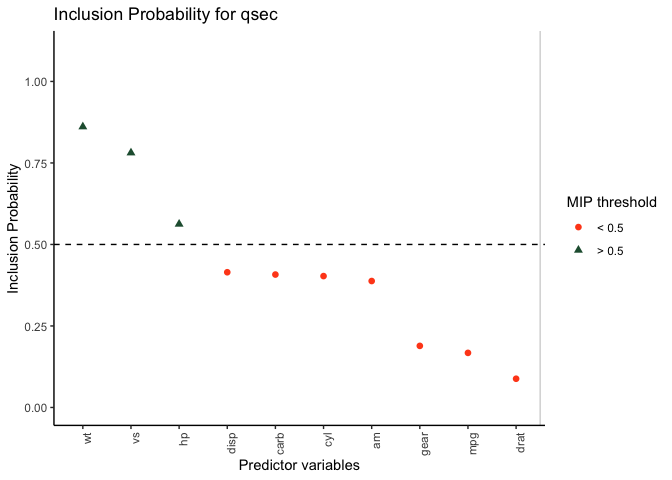
| wt | 0.8433 | 1.0433 | 0.0000 | 1.9513 | 1.2372 |
| vs | 0.7512 | 0.6399 | 0.0000 | 1.1982 | 0.8519 |
| hp | 0.5413 | -0.4995 | -1.3349 | 0.0000 | -0.9228 |
| cyl | 0.4551 | -0.5173 | -1.7670 | 0.0005 | -1.1367 |
| am | 0.4240 | -0.3107 | -1.0805 | 0.0000 | -0.7328 |
| disp | 0.4130 | -0.4553 | -1.8170 | 0.0012 | -1.1023 |
| carb | 0.3938 | -0.2890 | -1.0068 | 0.0000 | -0.7338 |
| gear | 0.2013 | -0.0918 | -0.5464 | 0.0002 | -0.4560 |
| mpg | 0.1584 | 0.0563 | -0.0001 | 0.4160 | 0.3557 |
| drat | 0.1003 | -0.0180 | -0.0008 | 0.0000 | -0.1794 |
The MIPs for each predictor can then be visualized using the plot() function.
plot(results)
Example 2 - binary response variable
In the example above, the response variable was a continuous variable. The same workflow can be used for binary variables by specifying continuous = FALSE to the ssvs() function.
As an example, let’s create a binary variable:
library(AER)
data(Affairs)
Affairs$hadaffair[Affairs$affairs > 0] <- 1
Affairs$hadaffair[Affairs$affairs == 0] <- 0
Then define the outcome and predictors.
outcome <- "hadaffair"
predictors <- c("gender", "age", "yearsmarried", "children", "religiousness", "education", "occupation", "rating")
And finally run the model:
results <- ssvs(data = Affairs, x = predictors, y = outcome, continuous = FALSE, progress = FALSE)
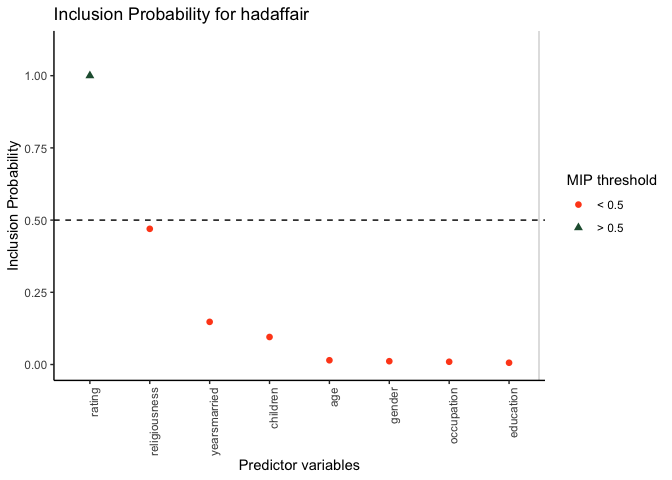
Now the results can be summarized or visualized in the same manner.
summary_results <- summary(results, interval = 0.9, ordered = TRUE)
| Variable | MIP | Avg Beta | Lower CI (90%) | Upper CI (90%) | Avg Nonzero Beta |
|---|---|---|---|---|---|
| rating | 0.9993 | -0.5553 | -0.7173 | -0.4027 | -0.5557 |
| religiousness | 0.4024 | -0.1332 | -0.4032 | 0.0000 | -0.3309 |
| children | 0.0955 | 0.0268 | 0.0000 | 0.0000 | 0.2804 |
| yearsmarried | 0.0899 | 0.0272 | 0.0000 | 0.0000 | 0.3020 |
| gender | 0.0075 | 0.0008 | 0.0000 | 0.0000 | 0.1092 |
| occupation | 0.0063 | 0.0006 | 0.0000 | 0.0000 | 0.0986 |
| age | 0.0058 | -0.0007 | 0.0000 | 0.0000 | -0.1202 |
| education | 0.0041 | 0.0004 | 0.0000 | 0.0000 | 0.1011 |
plot(results)
Interactive version
You can launch an interactive (shiny) web application that lets you run SSVS analyses without programming. Simply install this package and run SSVS::launch() in an R console.