

Description
Topological Data Analysis: Simplicial Complex.
Description
Provides an implementation of simplicial complexes for Topological Data Analysis (TDA). The package includes functions to compute faces, boundary operators, Betti numbers, Euler characteristic, and to construct simplicial complexes. It also implements persistent homology, from building filtrations to computing persistence diagrams, with the aim of helping readers understand the core concepts of computational topology. Methods are based on standard references in persistent homology such as Zomorodian and Carlsson (2005) <doi:10.1007/s00454-004-1146-y> and Chazal and Michel (2021) <doi:10.3389/frai.2021.667963>.
README.md
Topological Data Analysis: Simplicial Complex
This package aims to provide a user-friendly TDA application. Although many TDA libraries, such as Dionysus, PHAT, and GUDHI, have been developed in Python and C++, I believe it would be valuable to implement simplicial complex functionality in R, making it compatible with the wide range of statistical methods available in R.
Goals
- This package will continue adding useful knowledge in the playground to help both me and the users understand the methods.
- Since this package computes simplicial complexes, more applications are expected in future versions.
Example code
# Get its' simplices by specific epsilon
points <- matrix(c(0, 1, 1, 0, 0, 0, 1, 1), ncol = 2)
epsilon <- 1.5
vr_complex <- VietorisRipsComplex(points, epsilon)

# You can find its' topology feature by using these functions
faces(vr_complex$simplices, target_dim=1)
boundary(vr_complex$simplices, 1)
betti_number(vr_complex$simplices, 1, tol=0.1)
euler_characteristic(simplices, tol=0.1)
abstract_simplicial_complex(simplices, 2)

# Plot the Vietoris-rips complex
plot(
  vr_complex$network,
  layout = points,
  vertex.label = 1:nrow(points),
  vertex.size = 12,
  edge.arrow.mode = 0,
  asp = 1
)

# Filtration, Boundary reduction, and Persistence informations
F <- build_vr_filtration(points, eps_max=1.2)
res <- boundary_info(F)
pairs <- extract_persistence_pairs(F, res$last_1, res$pivot_owner)
plot_persistence(pairs)
Playground
Try this playground to get familier with all of the concept that will be used in TDA.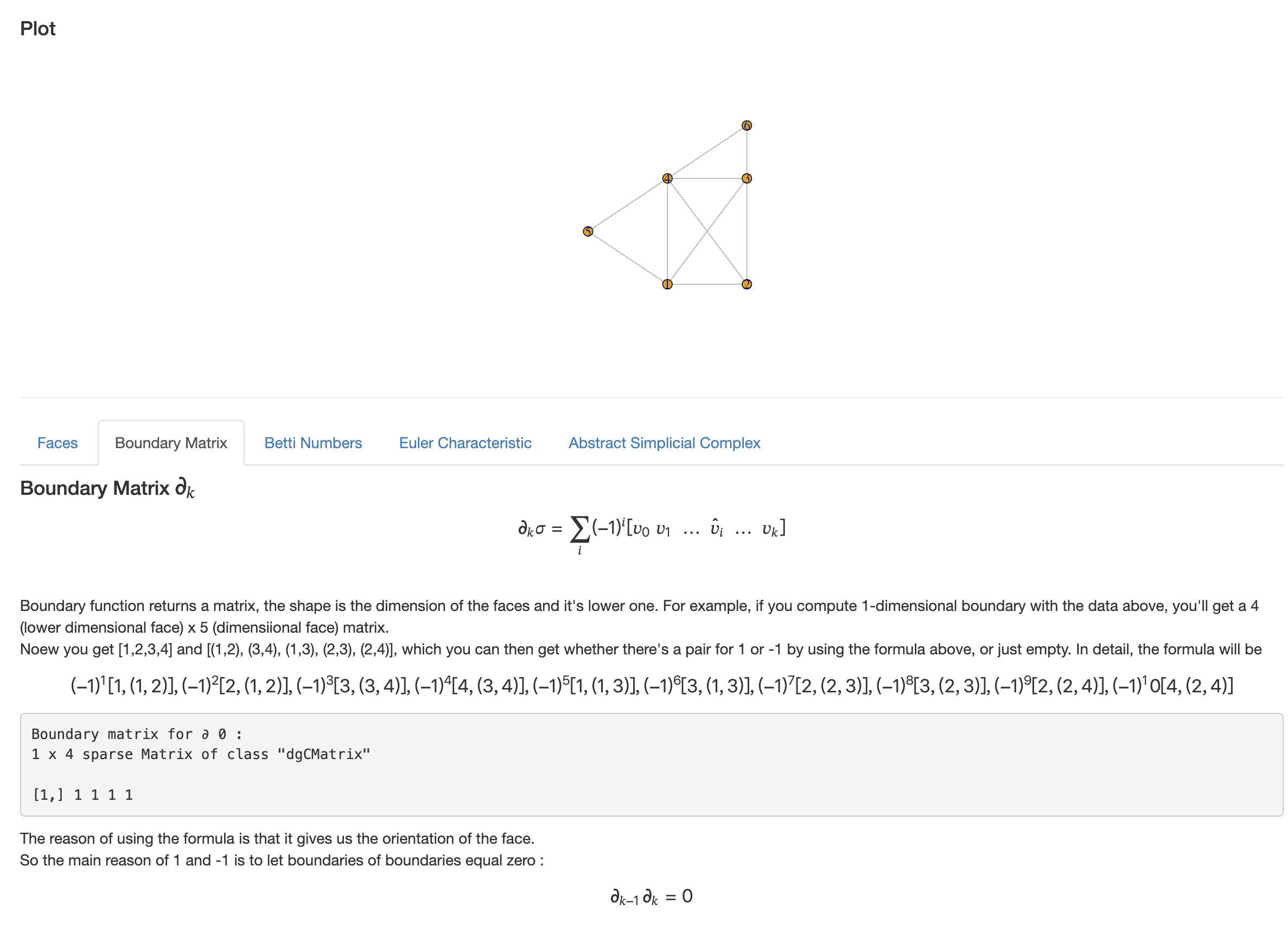
Reference
- Zomorodian, A., & Carlsson, G. (2004, June). Computing persistent homology. In Proceedings of the twentieth annual symposium on Computational geometry (pp. 347-356).
- Chazal, F., & Michel, B. (2021). An introduction to topological data analysis: fundamental and practical aspects for data scientists. Frontiers in artificial intelligence, 4, 667963.