

Description
Automatic Database Normalisation for Data Frames.
Description
Automatic normalisation of a data frame to third normal form, with the intention of easing the process of data cleaning. (Usage to design your actual database for you is not advised.) Originally inspired by the 'AutoNormalize' library for 'Python' by 'Alteryx' (<https://github.com/alteryx/autonormalize>), with various changes and improvements. Automatic discovery of functional or approximate dependencies, normalisation based on those, and plotting of the resulting "database" via 'Graphviz', with options to exclude some attributes at discovery time, or remove discovered dependencies at normalisation time.
README.md
autodb
autodb is an R package for automatic normalisation of a data frame to third normal form, with the intention of easing the process of data cleaning. (Usage to design your actual database for you is not advised.)
Installation
Install the stable released version from CRAN with:
install.packages("autodb")
Install the unstable development version from GitHub with:
# install.packages("devtools")
devtools::install_github("CharnelMouse/autodb")
Example
Turning a simple data frame into a database:
library(autodb)
#>
#> Attaching package: 'autodb'
#> The following object is masked from 'package:stats':
#>
#>     decompose
summary(ChickWeight)
#>      weight           Time           Chick     Diet
#>  Min.   : 35.0   Min.   : 0.00   13     : 12   1:220
#>  1st Qu.: 63.0   1st Qu.: 4.00   9      : 12   2:120
#>  Median :103.0   Median :10.00   20     : 12   3:120
#>  Mean   :121.8   Mean   :10.72   10     : 12   4:118
#>  3rd Qu.:163.8   3rd Qu.:16.00   17     : 12
#>  Max.   :373.0   Max.   :21.00   19     : 12
#>                                  (Other):506
db <- autodb(ChickWeight)
db
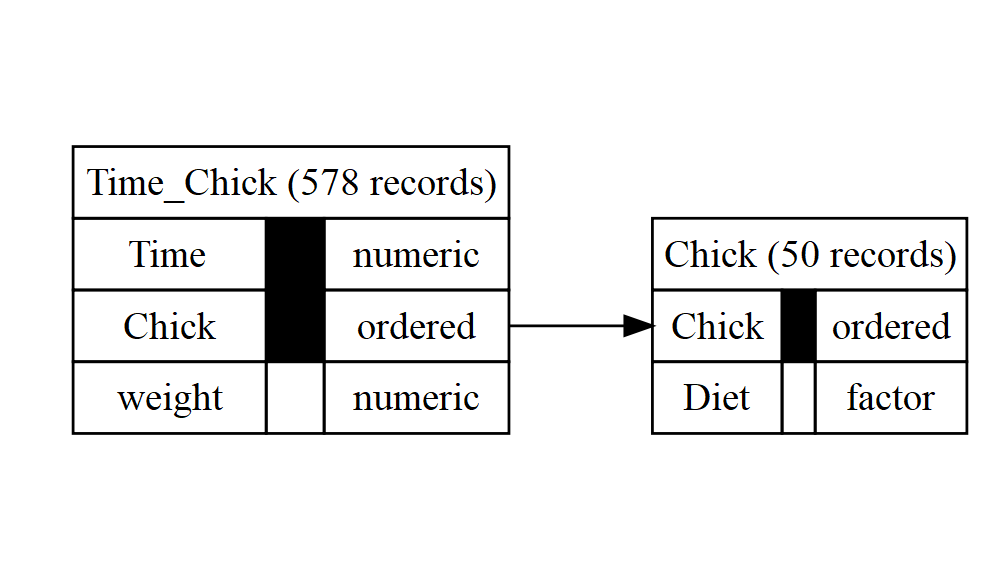
#> database with 2 relations
#> 4 attributes: weight, Time, Chick, Diet
#> relation Chick: Chick, Diet; 50 records
#>   key 1: Chick
#> relation Time_Chick: Time, Chick, weight; 578 records
#>   key 1: Time, Chick
#> references:
#> Time_Chick.{Chick} -> Chick.{Chick}
graphviz_text <- gv(db)
DiagrammeR::grViz(graphviz_text)
Using the exclude argument to forbid certain variables from appearing in keys:
summary(CO2)
#>      Plant             Type         Treatment       conc          uptake
#>  Qn1    : 7   Quebec     :42   nonchilled:42   Min.   :  95   Min.   : 7.70
#>  Qn2    : 7   Mississippi:42   chilled   :42   1st Qu.: 175   1st Qu.:17.90
#>  Qn3    : 7                                    Median : 350   Median :28.30
#>  Qc1    : 7                                    Mean   : 435   Mean   :27.21
#>  Qc3    : 7                                    3rd Qu.: 675   3rd Qu.:37.12
#>  Qc2    : 7                                    Max.   :1000   Max.   :45.50
#>  (Other):42
db2_noexclude <- autodb(CO2)
db2_noexclude
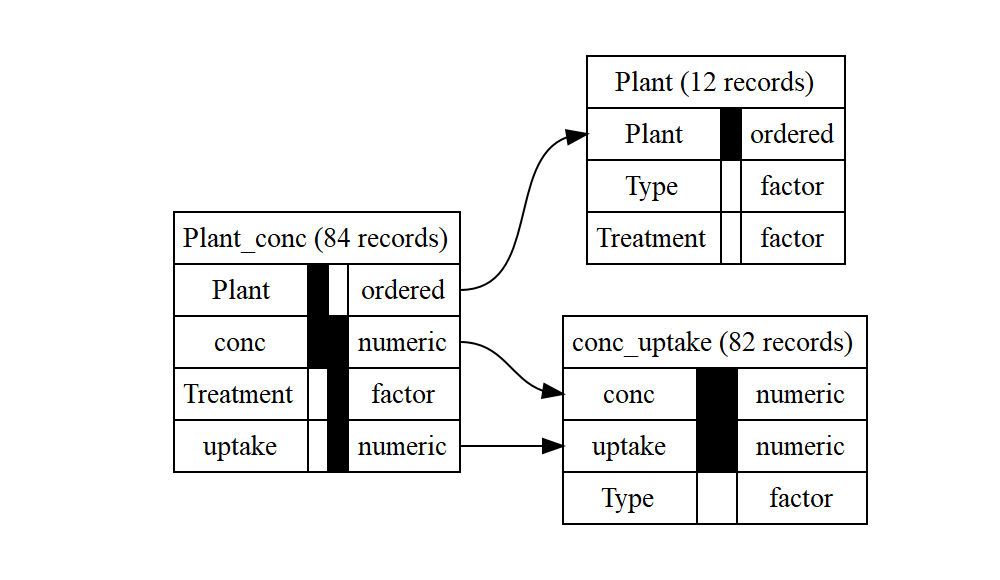
#> database with 3 relations
#> 5 attributes: Plant, Type, Treatment, conc, uptake
#> relation Plant: Plant, Type, Treatment; 12 records
#>   key 1: Plant
#> relation Plant_conc: Plant, conc, Treatment, uptake; 84 records
#>   key 1: Plant, conc
#>   key 2: Treatment, conc, uptake
#> relation conc_uptake: conc, uptake, Type; 82 records
#>   key 1: conc, uptake
#> references:
#> Plant_conc.{Plant} -> Plant.{Plant}
#> Plant_conc.{conc, uptake} -> conc_uptake.{conc, uptake}
graphviz_text2_noexclude <- gv(db2_noexclude)
DiagrammeR::grViz(graphviz_text2_noexclude)
db2 <- autodb(CO2, exclude = "uptake")
db2
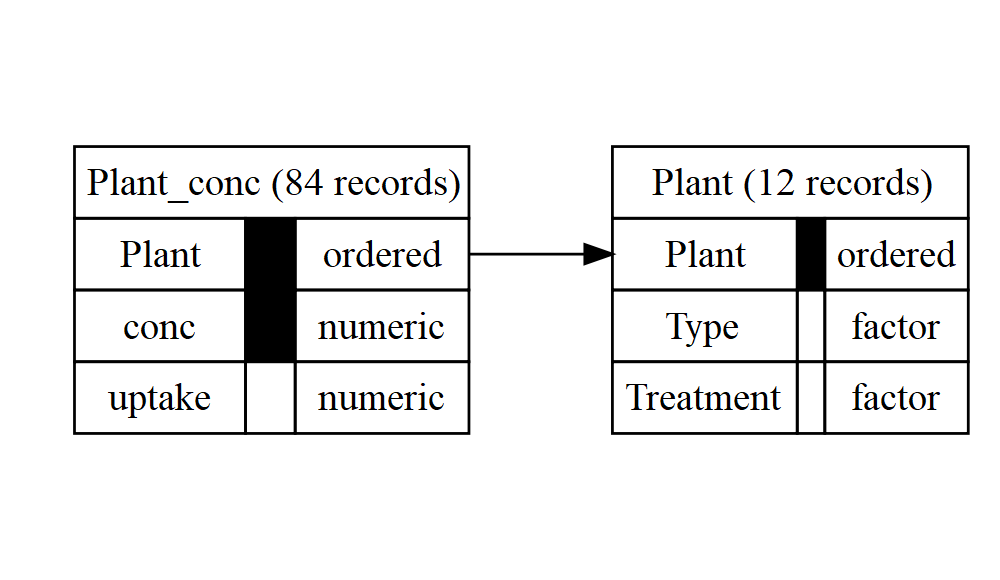
#> database with 2 relations
#> 5 attributes: Plant, Type, Treatment, conc, uptake
#> relation Plant: Plant, Type, Treatment; 12 records
#>   key 1: Plant
#> relation Plant_conc: Plant, conc, uptake; 84 records
#>   key 1: Plant, conc
#> references:
#> Plant_conc.{Plant} -> Plant.{Plant}
graphviz_text2 <- gv(db2)
DiagrammeR::grViz(graphviz_text2)
There are also functions for doing each step of the database creation separately, including functional dependency detection and normalisation. See the vignette for more details.