HMM Toolkit for Inferring IBD Segments from SNP Genotypes.
ibdfindr
The goal of ibdfindr is to detect genomic regions shared identical by descent (IBD) between two individuals, using SNP genotypes. It does so by fitting a continuous-time hidden Markov model (HMM) to the data.
Installation
Until ibdfindr becomes available on CRAN, you may install the development version from GitHub:
remotes::install_github("magnusdv/ibdfindr")
Example
library(ibdfindr)
As an example we consider the built-in dataset cousinsDemo, which contains almost 4000 SNP genotypes for two related individuals (in fact, a pair of cousins).
head(cousinsDemo)
#>   CHROM     MARKER       MB        CM A1 A2  FREQ1 ID1 ID2
#> 1     1  rs9442372 1.083324 0.0000000  A  G 0.3890 A/G G/G
#> 2     1  rs4648727 1.844830 0.1803812  A  C 0.3628 A/C A/C
#> 3     1 rs10910082 2.487496 1.2670505  C  T 0.3740 C/T C/T
#> 4     1  rs6695131 3.084360 1.9782286  C  T 0.5719 C/T C/T
#> 5     1  rs3765703 3.675872 4.8403127  G  T 0.4058 G/G T/T
#> 6     1  rs7367066 3.887191 5.7748481  C  T 0.6739 C/C C/C
The function findIBD() conveniently wraps the key steps of the package:
- Fit a continuous-time HMM to the data (
fitHMM()) - Find the most likely set of IBD segments (
findSegments()) - Calculate the posterior IBD probability at each marker (
ibdPosteriors())
ibd = findIBD(cousinsDemo)
#> Individuals: ID1, ID2
#> Chromosome type: autosomal
#> Fitting HMM parameters...
#>   Optimising `k1` and `a` jointly; method: L-BFGS-B
#>   k1 = 0.185, a = 7.430
#> Finding IBD segments...
#>   14 segments (total length: 597.21 cM)
#> Calculating IBD posteriors...
#> Analysis complete in 0.937 secs
For details of the different steps, see the documentation of the individual functions: fitHMM(), findSegments(), and ibdPosteriors().
To visualise the results we pass the output to plotIBD(). This plots the posterior probabilities on a background (grey points) showing the identity-by-state (IBS) status at each marker, i.e. whether the individuals have 0, 1 or 2 alleles in common. Inferred IBD regions are shown as red segments at the bottom of each chromosome panel.
plotIBD(ibd)
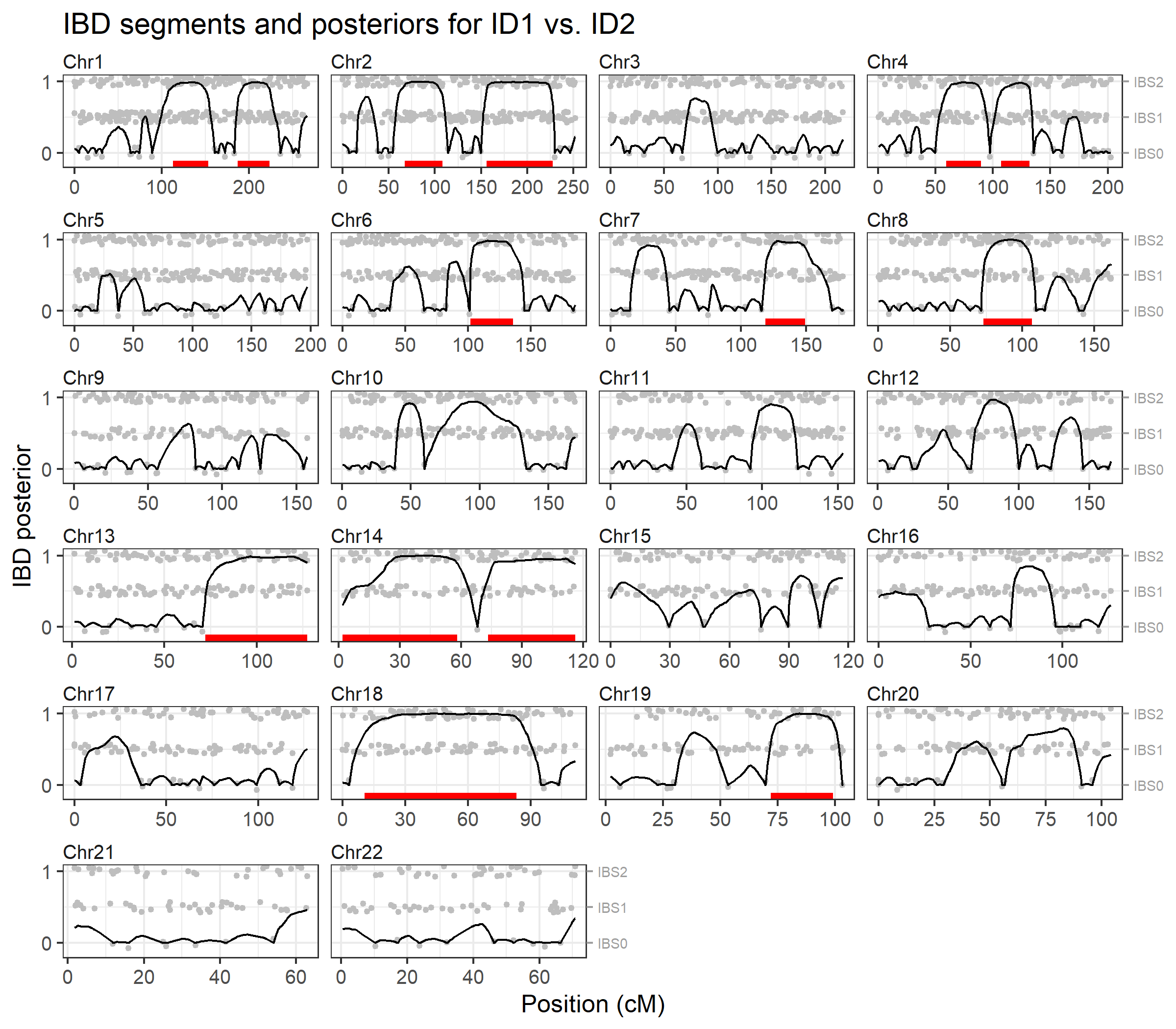
We may also inspect the identified segments as a data frame, showing the start and end positions, and the number of markers in each segment:
ibd$segments
#>    chrom    startCM     endCM   n
#> 1      1 113.000492 153.08623  54
#> 2      1 186.630319 223.39542  46
#> 3      2  67.118524 108.35905  50
#> 4      2 156.120361 227.62362  90
#> 5      4  59.474215  89.85522  41
#> 6      4 106.931772 131.69280  35
#> 7      6 102.041153 136.17734  43
#> 8      7 118.702115 149.11283  38
#> 9      8  72.976430 106.82971  55
#> 10    13  72.049460 127.22724  63
#> 11    14   1.808552  58.07117  67
#> 12    14  73.201009 116.00254  49
#> 13    18  10.592411  83.28443 101
#> 14    19  72.014020  99.15558  34
X-chromosome example
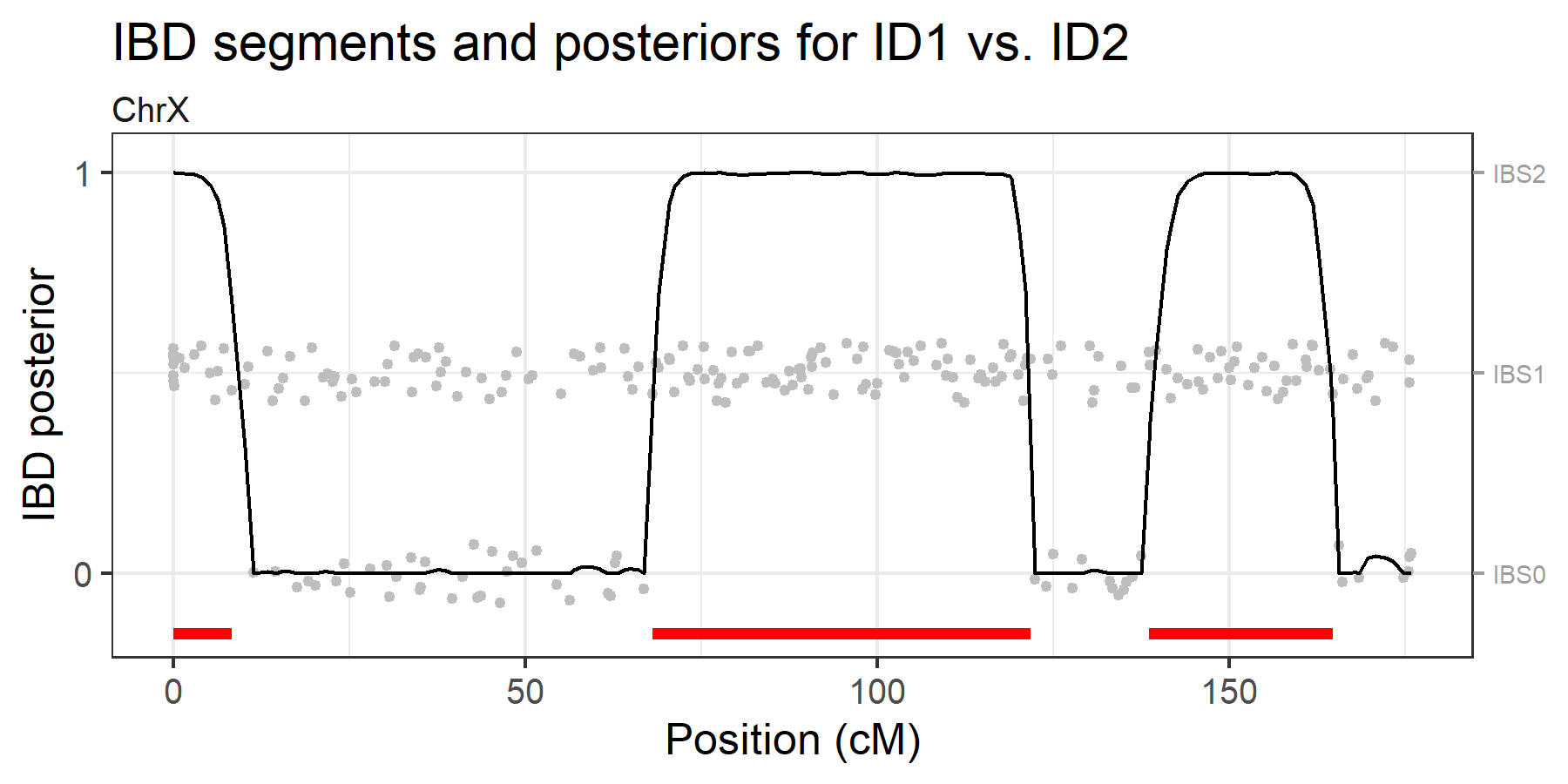
The brothersX dataset contains genotypes for two brothers typed with 246 X-chromosomal SNPs. The analysis below indicates that they share 3 IBD segments on the X chromosome.
ibdX = findIBD(brothersX)
#> Individuals: ID1, ID2
#> Chromosome type: X (male/male)
#> Fitting HMM parameters...
#>   Optimising `k1` and `a` jointly; method: L-BFGS-B
#>   k1 = 0.649, a = 6.635
#> Finding IBD segments...
#>   3 segments (total length: 88.05 cM)
#> Calculating IBD posteriors...
#> Analysis complete in 0.1 secs

plotIBD(ibdX)