

Tools for Educational and Psychological Measurement.
measureR 


measureR is an an R Shiny application for educational and psychological measurement, including:
- Content Validity (CV)
- Exploratory Factor Analysis (EFA)
- Confirmatory Factor Analysis (CFA)
- Classical Test Theory (CTT)
- Item Response Theory (IRT)
All analyses can be performed without writing any code, making the package accessible for researchers, students, and applied analysts.
Installation
# Install from CRAN (when available)
install.packages("measureR")

# Install development version from GitHub (optional)
remotes::install_github("hdmeasure/measureR")
Launch the Application
library(measureR)
measureR::run_measureR()
This opens the full Shiny application, including all measureR modules, data upload, built-in datasets, interactive plots, and reporting features.
Video Tutorial
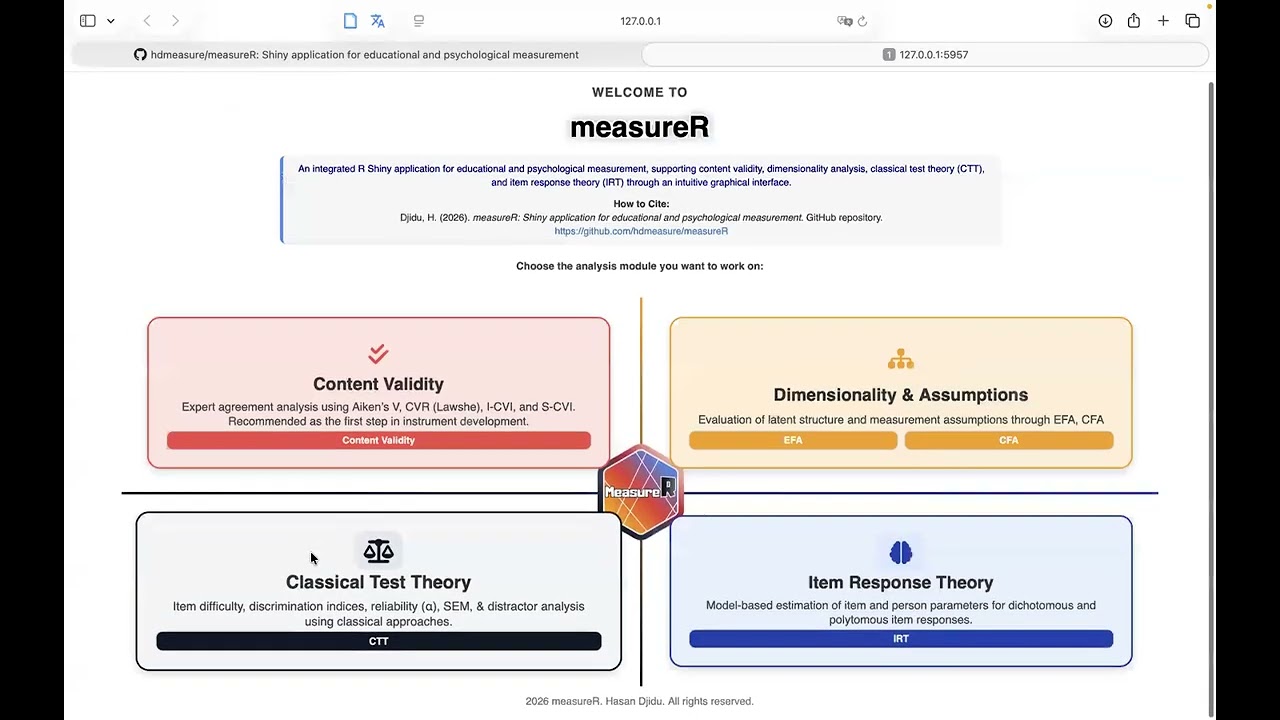
🎬 Click the image to watch the installation and quick-start tutorial for measureR.
Features
✔ Content Validity (CV)
- Aiken’s V, CVR (Lawshe), I-CVI, and S-CVI/Ave computation.
- Automatic critical value comparison and interpretation badges.
- Clear tabular summaries and export-ready results.
✔ Exploratory Factor Analysis (EFA)
- KMO, Bartlett test, parallel analysis.
- Factor extraction with rotation.
- Factor scores and loading matrix export.
- Clean HTML summaries for clearer interpretation.
✔ Confirmatory Factor Analysis (CFA)
- Lavaan model editor.
- Fit measures, loadings, factor scores.
- Fully customized SEM path diagrams.
✔ Classical Test Theory (CTT)
- Item difficulty and discrimination indices.
- Test reliability (α), SEM, and score distribution analysis.
- Distractor analysis for multiple-choice items.
- Comprehensive item and test-level summary outputs.
✔ Item Response Theory (IRT)
- Supports dichotomous and polytomous items.
- Automatically fits Rasch, 2PL, 3PL (or PCM/GRM/GPCM).
- ICC plots, test information, factor scores.
- Multi-dimensional visualization with 3D surfaces and heatmaps.
Live Demo (Shiny Application)
The full functionality of measureR is available through an interactive Shiny web application.
👉 Launch the live application:
https://measure.shinyapps.io/measureR/
The web interface provides direct access to all analysis modules, including Content Validity, Exploratory and Confirmatory Factor Analysis, Classical Test Theory, and Item Response Theory, allowing users to explore the application without local installation.
Citation
If you use measureR in publications, please cite:
Djidu, H. (2026). measureR: Tools for educational and psychological measurement. https://github.com/hdmeasure/measureR. R Packages.
Contributing
Bug reports and feature requests are welcome:
https://github.com/hdmeasure/measureR/issues
License
MIT License © 2026 Hasan Djidu.