

Load Data from the MeLiDos Field Study.
melidosData 

melidosData helps you load data from the MeLiDos field study. It also contains helpers to work with REDCap dictionaries and metadata.
The project
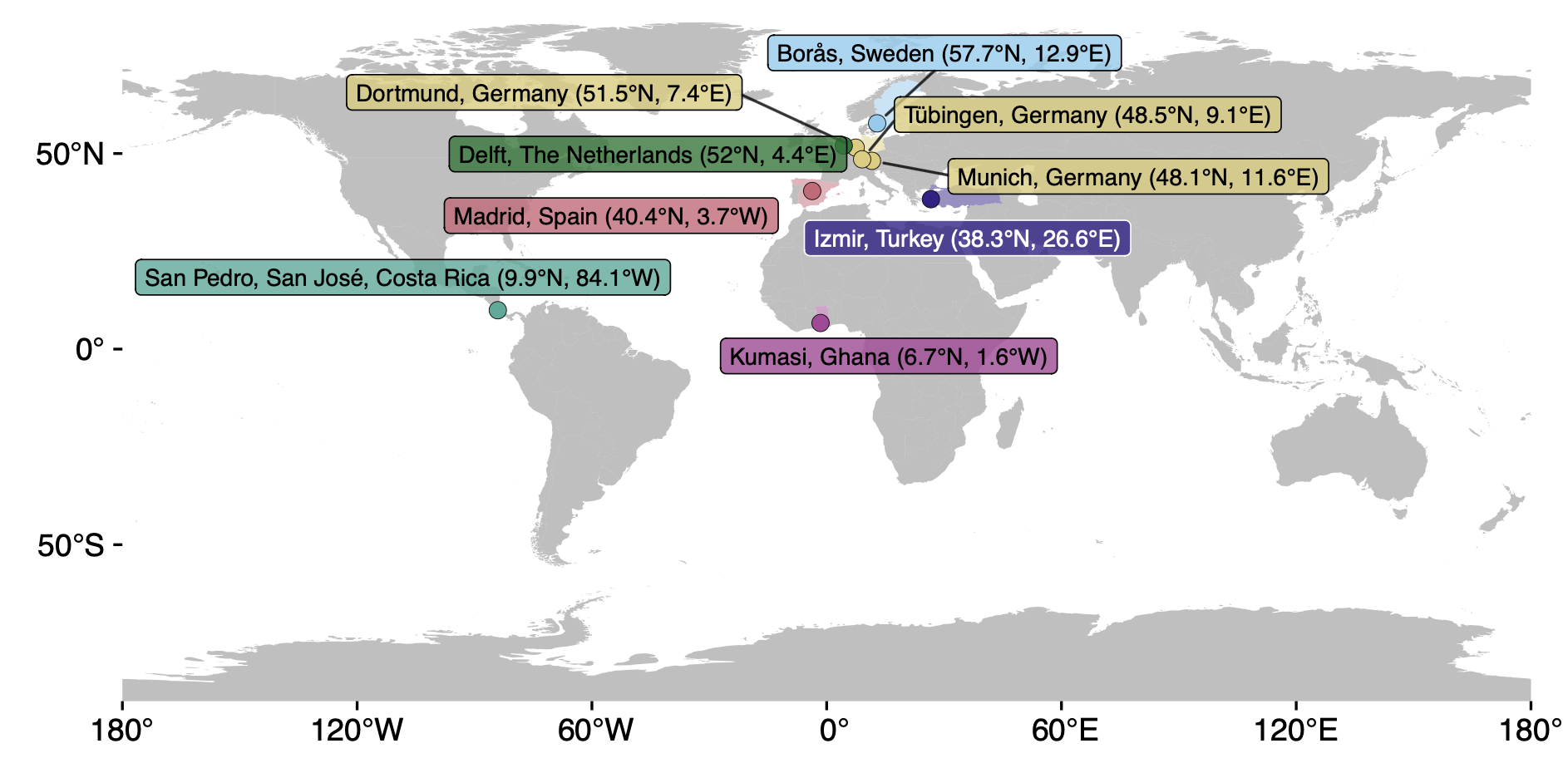
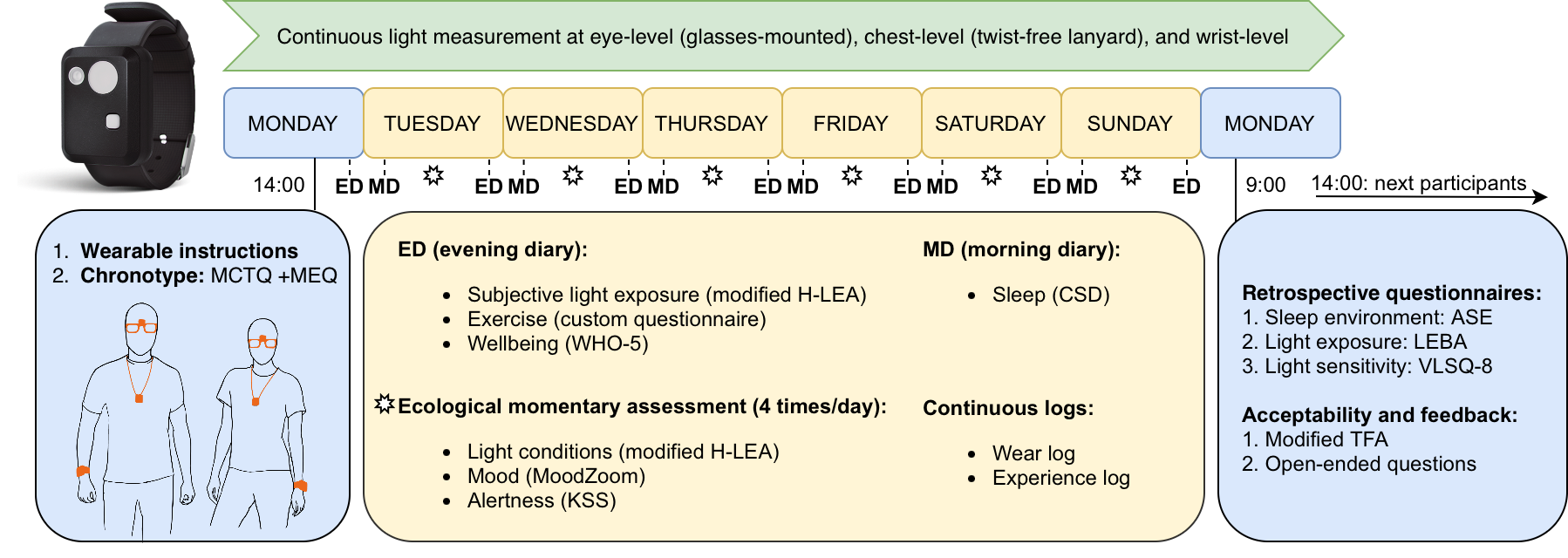
The MeLiDos field study datasets contain wearable data for personal light exposure at the eye, chest, and wrist level for 191 participants across 9 sites and 7 countries, capturing 1480 participant days of annotated data. Through a host of questionnaires at screening and discharge time, ecological momentary assessment, diaries, and logs, extensive auxiliary data are available.
- Main workflow:
load_data()downloads a modality for one or many sites.flatten_data()combines multi-site lists into one analysis-ready table, including a shared timezone.
| Institution (site Abbr.) | City | Country | Repository | DOI |
|---|---|---|---|---|
| RISE | Borås | Sweden | NilssonTengelinEtAl_Dataset_2026 | 10.5281/zenodo.18925834 |
| THUAS | Delft | The Netherlands | AertsEtAl_Dataset_2025 | 10.5281/zenodo.17979893 |
| BAUA | Dortmund | Germany | BroszioEtAl_Dataset_2025 | 10.5281/zenodo.18111232 |
| MPI | Tübingen | Germany | GuidolinEtAl_Dataset_2025 | 10.5281/zenodo.16895188 |
| TUM | Munich | Germany | HildenEtAl_Dataset_2025 | 10.5281/zenodo.16893901 |
| FUSPCEU | Madrid | Spain | BaezaEtAl_Dataset_2025 | 10.5281/zenodo.16834951 |
| IZTECH | Izmir | Turkey | DidikogluEtAl_Dataset_2025 | 10.5281/zenodo.16568109 |
| UCR | San José | Costa Rica | Sancho-SalasEtAl_Dataset_2025 | 10.5281/zenodo.17289456 |
| KNUST | Kumasi | Ghana | AkuffoEtAl_Dataset_2025 | 10.5281/zenodo.15576731 |
Overview of the available sites in the package
Installation
You can install the CRAN version of melidosData with:
install.packages("melidosData")
You can install the development version of melidosData from GitHub with:
# install.packages("pak")
pak::pak("MeLiDosProject/melidosData")
Main workflow example
library(melidosData)
library(LightLogR) #for visualization
library(dplyr) #for data manipulation

# one site -> data frame
sleep_tum <- load_data("sleepdiaries", site = "TUM")
sleep_tum |> select(Id, sleep, wake) |> head()
#> # A tibble: 6 × 3
#>   Id       sleep               wake
#>   <chr>    <dttm>              <dttm>
#> 1 TUM_S001 2024-05-14 00:25:00 2024-05-14 09:38:00
#> 2 TUM_S001 2024-05-15 00:17:00 2024-05-15 08:00:00
#> 3 TUM_S001 2024-05-16 00:32:00 2024-05-16 10:00:00
#> 4 TUM_S001 2024-05-17 01:25:00 2024-05-17 09:30:00
#> 5 TUM_S001 2024-05-18 00:35:00 2024-05-18 09:30:00
#> 6 TUM_S001 2024-05-19 05:32:00 2024-05-19 11:30:00

# many sites -> `melidos_data` list
sleep_all <- load_data("sleepdiaries", site = c("TUM", "UCR"))
sleep_all |> summary()
#>     Length Class  Mode
#> TUM 14     tbl_df list
#> UCR 14     tbl_df list

# flatten list output for analysis
sleep_all_flat <- flatten_data(sleep_all, tz = "UTC")
sleep_all_flat |>
  select(site, Id, sleep, wake) |>
  group_by(site) |>
  slice_head(n=3)
#> # A tibble: 6 × 4
#> # Groups:   site [2]
#>   site  Id       sleep               wake
#>   <chr> <chr>    <dttm>              <dttm>
#> 1 TUM   TUM_S001 2024-05-14 00:25:00 2024-05-14 09:38:00
#> 2 TUM   TUM_S001 2024-05-15 00:17:00 2024-05-15 08:00:00
#> 3 TUM   TUM_S001 2024-05-16 00:32:00 2024-05-16 10:00:00
#> 4 UCR   UCR_S001 2025-06-16 21:35:00 2025-06-17 06:36:00
#> 5 UCR   UCR_S001 2025-06-17 21:35:00 2025-06-18 06:30:00
#> 6 UCR   UCR_S001 2025-06-18 22:25:00 2025-06-19 06:40:00
Modalities
The following list of modalities contains the modality codes to be used in load_data().
Light exposure:
light_glasses, light_chest, light_wrist: personal light exposure datasets, captured with
ActLumusdevices, recorded in 10 second intervals for the eye-level, chest-level, and wrist-level position. Data are minimally checked after import (range, explicit gaps, device malfunctions, time shifts).light_glasses_1minute, light_chest_1minute, light_wrist_1minute: as above, but aggregated to 1-minute intervals. Furthermore, days with less than 80% of data coverage are removed. This makes the datasets both faster to download, computationally easier to work with, and also more stable to calculate light exposure metrics
Questionnaires (screening and discharge):
- health: Lifestyle and health
- demographics: Demographics
- chronotype: Chronotype (MCTQ, MEQ)
- accectability: Light glasses acceptability
- ase: Sleep environment (ASE)
- evaluation: Evaluation of study by participants
- leba: Light exposure behavior (LEBA)
- vlsq8: Light sensitivity (VLSQ-8)
Diaries (morning or evening):
- sleepdiaries: Sleepdiary
- lightexposurediary: Light exposure diary (mH-LEA) and activity diary
- exercisediary: Exercise diary
- wellbeingdiary: Wellbeing diary (WHO-5)
Logs (when required):
- wearlog: Wear/Non-wear log
- experiencelog: Experience log
Ecological momentary assessment (4 times per day):
- currentconditions: Current light, mood, and alertness
Sites
The nine sites are centered on universities and research institutes. The packages contains relevant metadata for these sites:
melidos_countries
#>              RISE           FUSPCEU              BAUA               TUM
#>          "Sweden"           "Spain"         "Germany"         "Germany"
#>               MPI             THUAS            IZTECH             KNUST
#>         "Germany" "The Netherlands"          "Turkey"           "Ghana"
#>               UCR
#>      "Costa Rica"
melidos_cities
#>                  RISE               FUSPCEU                  BAUA
#>               "Borås"              "Madrid"            "Dortmund"
#>                   TUM                   MPI                 THUAS
#>              "Munich"            "Tübingen"               "Delft"
#>                IZTECH                 KNUST                   UCR
#>               "Izmir"              "Kumasi" "San Pedro, San José"
melidos_colors
#>      RISE   FUSPCEU      BAUA       TUM       MPI     THUAS    IZTECH     KNUST
#> "#88CCEE" "#CC6677" "#DDCC77" "#DDCC77" "#DDCC77" "#117733" "#332288" "#AA4499"
#>       UCR
#> "#44AA99"
melidos_coordinates
#> $RISE
#> [1] 57.71567 12.89087
#>
#> $FUSPCEU
#> [1] 40.41650 -3.70256
#>
#> $BAUA
#> [1] 51.498204  7.416708
#>
#> $TUM
#> [1] 48.1333 11.5667
#>
#> $MPI
#> [1] 48.5216  9.0576
#>
#> $THUAS
#> [1] 52.0116  4.3571
#>
#> $IZTECH
#> [1] 38.32 26.63
#>
#> $KNUST
#> [1]  6.675007 -1.572644
#>
#> $UCR
#> [1]   9.9372 -84.0509
melidos_tzs
#>                 RISE              FUSPCEU                 BAUA
#>   "Europe/Stockholm"      "Europe/Madrid"      "Europe/Berlin"
#>                  TUM                  MPI                THUAS
#>      "Europe/Berlin"      "Europe/Berlin"   "Europe/Amsterdam"
#>               IZTECH                KNUST                  UCR
#>    "Europe/Istanbul"       "Africa/Accra" "America/Costa_Rica"
More information is found under the full repository of each dataset on the project page.
Mini vignette: REDCap helper workflow
# 1) load dictionary and clean labels
codebook_path <- system.file("ext", "DataDictionary_sleepdiary.csv", package = "melidosData")
codebook <- utils::read.csv(codebook_path, check.names = FALSE)
codebook_clean <- REDCap_codebook_prepare(codebook)
codebook_clean |> names()
#>  [1] "Variable / Field Name"
#>  [2] "Form Name"
#>  [3] "Section Header"
#>  [4] "Field Type"
#>  [5] "Field Label"
#>  [6] "Choices, Calculations, OR Slider Labels"
#>  [7] "Field Note"
#>  [8] "Text Validation Type OR Show Slider Number"
#>  [9] "Text Validation Min"
#> [10] "Text Validation Max"
#> [11] "Identifier?"
#> [12] "Branching Logic (Show field only if...)"
#> [13] "Required Field?"
#> [14] "Custom Alignment"
#> [15] "Question Number (surveys only)"
#> [16] "Matrix Group Name"
#> [17] "Matrix Ranking?"
#> [18] "Field Annotation"

# 2) start with example REDCap export
sleep <- REDCap_example_sleep
sleep$sleepquality #original
#> [1] 3 3 2 5 2 3 3 2 4

# 3) check expected column types against dictionary metadata
check <- REDCap_coltype_check(codebook_clean, data = sleep)
check$ok
#> [1] TRUE
check$details
#> # A tibble: 16 × 6
#>    col              expected  present actual    type_ok issue
#>    <chr>            <chr>     <lgl>   <chr>     <lgl>   <chr>
#>  1 bedtime          POSIXct   TRUE    POSIXct   TRUE    ok
#>  2 sleep            POSIXct   TRUE    POSIXct   TRUE    ok
#>  3 offset           POSIXct   TRUE    POSIXct   TRUE    ok
#>  4 out_ofbed        POSIXct   TRUE    POSIXct   TRUE    ok
#>  5 sleepdelay       numeric   TRUE    numeric   TRUE    ok
#>  6 awakenings       numeric   TRUE    numeric   TRUE    ok
#>  7 awake_duration   numeric   TRUE    numeric   TRUE    ok
#>  8 sleepquality     numeric   TRUE    numeric   TRUE    ok
#>  9 daytype2         numeric   TRUE    numeric   TRUE    ok
#> 10 status           numeric   TRUE    numeric   TRUE    ok
#> 11 scheduledate     Date      TRUE    Date      TRUE    ok
#> 12 record_id        character TRUE    character TRUE    ok
#> 13 comments         character TRUE    character TRUE    ok
#> 14 uuid             character TRUE    character TRUE    ok
#> 15 supplementaldata character TRUE    character TRUE    ok
#> 16 serializedresult character TRUE    character TRUE    ok

# 4) convert factor numbers into factors
sleep_factors <- REDCap_factors(sleep, codebook_clean)
sleep_factors$sleepquality #factors
#> [1] Fair      Fair      Poor      Very good Poor      Fair      Fair
#> [8] Poor      Good
#> Levels: Very poor Poor Fair Good Very good

# 5) attach human-readable labels from dictionary
sleep_labelled <- REDCap_col_labels(sleep_factors, codebook_clean)
sleep_labelled$sleepquality #factors with label
#> [1] Fair      Fair      Poor      Very good Poor      Fair      Fair
#> [8] Poor      Good
#> attr(,"label")
#> [1] How would you rate the quality of your sleep?
#> Levels: Very poor Poor Fair Good Very good

#6) add arbitrary labels, e.g. for computed variables
sleep_labelled <- sleep_labelled |> mutate(actual_sleep = sleep + sleepdelay*60)
sleep_labelled$actual_sleep |> attr("label") # incorrect label (taken from sleep)
#> [1] "What time did you try to go to sleep?"

sleep_labelled <- sleep_labelled |> add_labels(c(actual_sleep = "Time of sleep including sleepdelay (calculated)"))
sleep_labelled$actual_sleep |> attr("label") #new label
#> [1] "Time of sleep including sleepdelay (calculated)"
Note: labels are volatile in R. If they are lost, e.g. after data transformation, the functions can be reexecuted.
About the MeLiDos project
MeLiDos is a joint, EURAMET-funded project involving sixteen partners across Europe, aimed at developing a metrology and a standard workflow for wearable light logger data and optical radiation dosimeters. Its primary contributions towards fostering FAIR data include the development of a common file format, robust metadata descriptors, and an accompanying open-source software ecosystem.


The project (22NRM05 MeLiDos) has received funding from the European Partnership on Metrology, co-financed from the European Union’s Horizon Europe Research and Innovation Programme and by the Participating States. Views and opinions expressed are however those of the author(s) only and do not necessarily reflect those of the European Union or EURAMET. Neither the European Union nor the granting authority can be held responsible for them.