Description
PDF Document Creator.
Description
PDF is a standard file format for laying out text and images in documents. At its core, these documents are sequences of objects defined in plain text. This package allows for the creation of PDF documents at a very low level without any library or graphics device dependencies.
README.md
minipdf 


minipdf is a package for creating simple PDF documents.
What’s in the box
create_pdf()to create an empty PDF documentwrite_pdf()to write a PDF to file or stringpdf_line(),pdf_rect(),pdf_circle(),pdf_polygon(),pdf_polyline(),pdf_text(),pdf_bezier(),pdf_image()- functions for adding graphical elements to the PDFpdf_clip_polygon(),pdf_clip_rect()define global clipping regionsclip_polygon(),clip_rect()define per-element clipping regionspdf_rotate(),pdf_translate(),pdf_scale()define global transformationstf_rotate(),tf_translate(),tf_scale()define per-element transformationspgpar()define PDF graphical parameterspdf_newpage()begin a new page in the PDF
Installation
You can install the development version from GitHub with:
# install.packages("devtools")
devtools::install_github("coolbutuseless/minipdf")
Hello World!
doc <- create_pdf(width = 400, height = 250) |>
  pdf_circle(80, 100, 50, fill = 'lightblue', col = 'black') |>
  pdf_rect(150, 50, 100, 100, fill = 'yellow', col = 'red', lty = 2) |>
  pdf_polygon(c(270, 390, 330), c(50, 50, 150)) |>
  pdf_text("Hello World!", x = 30, y = 170, fontsize = 50)
write_pdf(doc, "man/figures/helloworld.pdf")
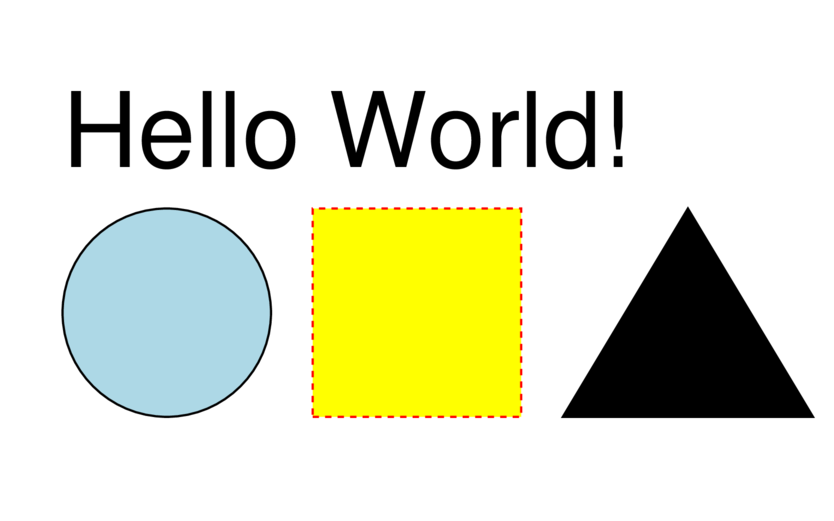
In write_pdf() if the output filename is not specified, then the function returns the PDF document as a string
write_pdf(doc) |> cat()
%PDF-1.7
1 0 obj
<<
  /Creator (minipdf/R)
  /CreationDate (D:202508230942)
>>
endobj
2 0 obj
<<
  /Type /Catalog
  /Pages 3 0 R
>>
endobj
3 0 obj
<<
  /Type /Pages
  /Resources 4 0 R
  /MediaBox [0 0 400 250]
  /Kids [ 5 0 R ]
  /Count 1
>>
endobj
4 0 obj
<<
  /ExtGState
  <<
    /GS1
    <<
      /CA 1
      /ca 1
    >>
  >>
  /Font
  <<
    /F1
    <<
      /Type /Font
      /Subtype /Type1
      /BaseFont /Helvetica
    >>
  >>
>>
endobj
5 0 obj
<<
  /Type /Page
  /Parent 3 0 R
  /Contents [6 0 R 7 0 R 8 0 R 9 0 R 10 0 R]
>>
endobj
6 0 obj
<<
  /Length 37
>>
stream
0 0 400 250 re W n
0 0 400 250 re W n
endstream
endobj
7 0 obj
<<
  /Length 284
>>
stream
q
0 0 0 RG
0.67843137254902 0.847058823529412 0.901960784313726 rg
130 100 m
130 127.61423749155  107.61423749155 150  80   150 c
52.38576250845 150  30 127.61423749155  30 100   c
30 72.38576250845  52.38576250845 50  80   50 c
107.61423749155 50  130 72.38576250845  130 100   c
b
Q
endstream
endobj
8 0 obj
<<
  /Length 49
>>
stream
q
1 0 0 RG
1 1 0 rg
[3] 0 d
150 50 100 100 re b
Q
endstream
endobj
9 0 obj
<<
  /Length 51
>>
stream
q
0 0 0 RG
0 0 0 rg
270 50 m 390 50 l 330 150 l b
Q
endstream
endobj
10 0 obj
<<
  /Length 70
>>
stream
q
0 0 0 RG
0 0 0 rg
BT
/F1 50 Tf
30 170 Td
0 Tr
(Hello World!) Tj
ET
Q
endstream
endobj
xref
0 11
0000000000 65535 f
0000000009 00000 n
0000000086 00000 n
0000000139 00000 n
0000000249 00000 n
0000000447 00000 n
0000000543 00000 n
0000000632 00000 n
0000000969 00000 n
0000001070 00000 n
0000001173 00000 n
trailer
<<
  /Size 11
  /Info 1 0 R
  /Root 2 0 R
>>
startxref
1296
%%EOF
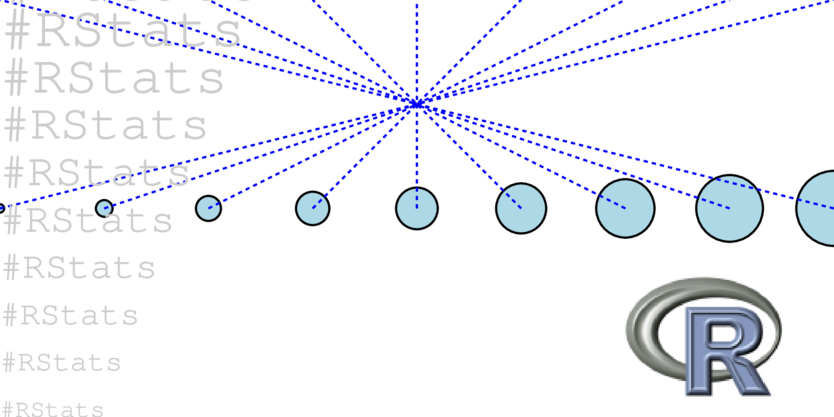
Simple example with vectorised arguments
Most coordinate arguments can be vectors - this means multiple objects can be generated with a single call.
Note that all objects created in this way share a single graphics state i.e. they’ll all be the same color etc.
im  <- png::readPNG(system.file("img", "Rlogo.png", package="png")) * 255


doc <- create_pdf(width = 400, height = 200) |>
  pdf_circle(
    x = seq(0, 400, length.out = 9),
    y = 100,
    r = 2 * (1:9),
    col = 'black', lwd = 1, fill = 'lightblue'
  ) |>
  pdf_line(
    x1 = seq(0, 400, length.out = 9),
    y1 = 100,
    x2 = seq(400, 0, length.out = 9),
    y2 = 200,
    lty = 3, col = 'blue'
  ) |>
  pdf_text(
    "#RStats",
    x = 0,
    y = seq(0, 200, length.out = 10),
    fill       = 'grey80',
    fontfamily = 'mono',
    fontsize   = seq(12, 30, length.out = 10)
  ) |>
  pdf_image(im = im, x = 300, y = 10, scale = 0.75)
write_pdf(doc, "man/figures/simple.pdf")
Multiple objects with differing graphics state
doc <- create_pdf(height = 400, width = 600)

N <- 400
xs <- sample(600, N, TRUE)
ys <- sample(400, N, TRUE)
rs <- sample(100, N, TRUE)
cs <- sample(colors(), N, TRUE)

for (i in seq_len(N)) {
  doc <- pdf_circle(doc, xs[i], ys[i], rs[i], col = NA, fill = cs[i], alpha = 0.2)
}

doc <- pdf_translate(doc, 50, 0)

doc <- pdf_text(doc, "#RStats", 10, 150, fontsize = 120, mode = 1, col = 'black',
                fontface = 'bold.italic', lwd = 5)
write_pdf(doc, "man/figures/example1.pdf")

Beziers
N <- 100

doc <- create_pdf() |>
  pdf_bezier(
    x0 = seq(0, 400, length.out = N),
    y0 = 10,
    x1 = 25,
    y1 = seq(20, 300, length.out = N),
    x2 = seq(100, 80, length.out = N),
    y2 = 250,
    x3 = 400,
    y3 = seq(400, 300, length.out = N),
    alpha = 0.2
  )
write_pdf(doc, "man/figures/beziers.pdf")