

Native R 'ONNX' Runtime.
nativeORT
Native ONNX Runtime inference for R, no Python required.
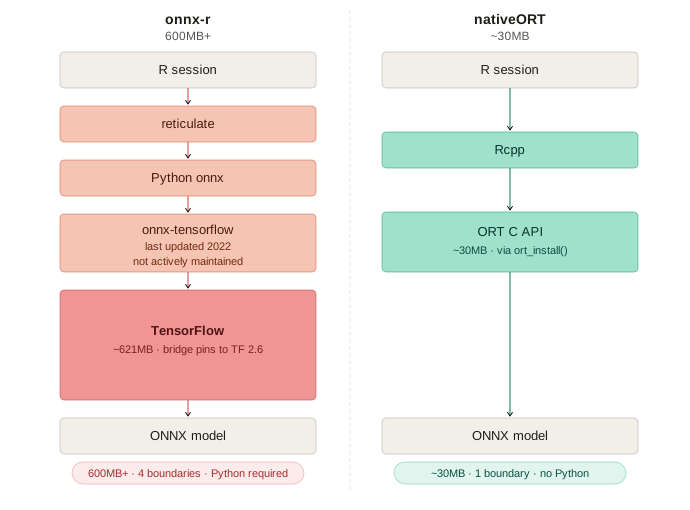
nativeORT is the only R-native ONNX inference engine with no Python/reticulate dependencies. Built on direct C++ bindings to the onnxruntime C API, inference runs entirely within R.
nativeORT can run at real-time speeds, and Apple Silicon users can access the CoreML Execution Provider. To the author's best research, this is the first R package with direct CoreML access which does not rely on reticulate or python bridging.
Why nativeORT?
The existing R interface for ONNX Runtime routes through Python/reticulate with Tensorflow backends in Python. Bridging, non-R dependencies, and a large footprint make this a non-ideal solution. As of publication, the existing packaging has not had a new release since 2021. Additionally, the onnx-tensorflow dependency has not been actively maintained. nativeORT exists to bridge this gap for AIML practitioners in R who want a modern, R-native approach that runs fast without a large number of dependencies.
Installation
Now available through CRAN!
install.packages('nativeORT')
Or, if you prefer the latest release from Github:
remotes::install_github("github.com/calebmcarr/nativeort")
nativeORT comes with a smart ONNX Runtime installer to detect your platform and install the correct ORT 1.25.1 binary and verify the install. On first install:
library(nativeORT)
ort_install()
library(nativeORT) # again, with ONNX libraries registered
After this, you can start inferencing on .onnx engines!
Usage
Creating an ORT Session
You'll need access to a .onnx file. Here's we'll use YOLOv11 nano from ultralytics as an example.
session <- nativeORT::ort_session(model_path)
Inferencing
Now that you've created an ORT session (which handles all of the threading setup, etc.), you can inference easily with standard R arrays.
# typical RGB 256x256 image
input <- array(
  runif(1 * 3 * 256 * 256),
  dim=c(1L, 3L, 256L, 256L)
)

raw <- nativeORT::ort_infer_raw(session, input)
CoreML Access
For users with Apple Silicon, nativeORT allows you to tap directly into the CoreML Execution Provider, with dedicated hardware for more stable inferencing.
It's easy, only requiring a change in the session creation:
// optional, explicitly creating cache dir helps speedup
dir.create(path.expand("~/.nativeORT/cache"),
           recursive = TRUE, showWarnings = FALSE
           )
session <- nativeORT::ort_session(model_path,
                                  provider='coreml',
                                  cache_dir=path.expand("~/.nativeORT/cache")
           )
Benchmarks
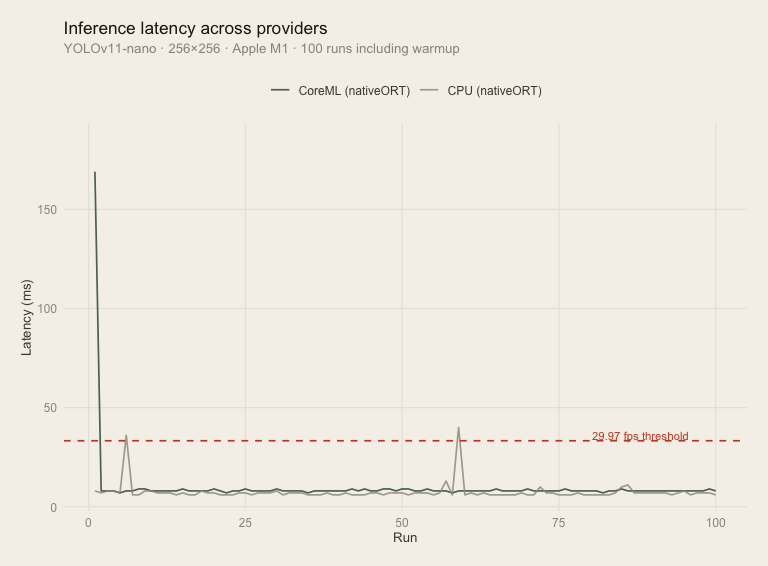
nativeORT is fast, and supports real-time inferencing, opening up video streaming possibilities without requiring Python.
Below is a benchmark on Apple M1 Silicon, targeting YOLOv11-nano on 50 consecutive 256x256 frames. Tested with both the CPU and CoreML providers, we have a median inference time of 7-8 milliseconds, respectively (further discussion at Benchmark Performance).
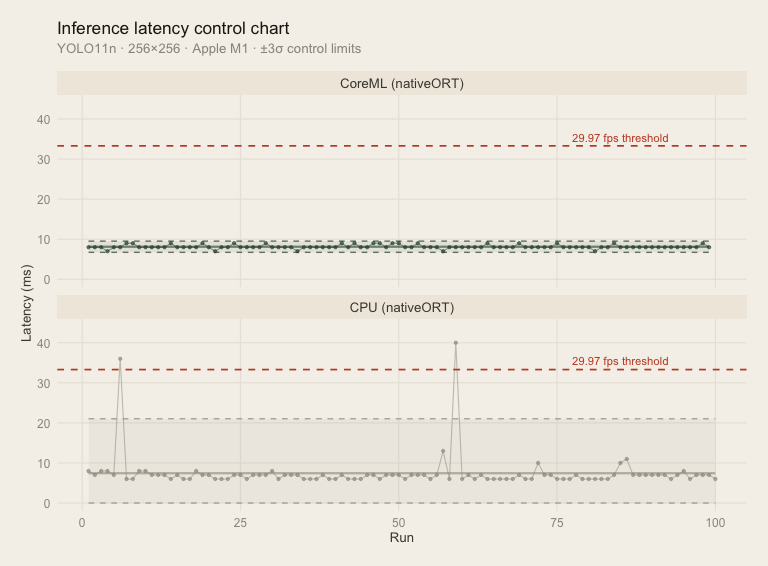
And here are the control charts for latency. Both providers are well within our threshold, even when accounting for a 3 sigma interval.Bene Nota: for this chart, the warmup was excluded.
AI Disclaimer
This code was written by me, and the logic human-made. The charts in this README were aided with the help of AI tooling, however, as my eye for graphic design is not quite as keen.
Author
Caleb Carr is an AI Engineer with an academic background in Applied Statistics.