

Simulate and Evaluate Targeted Interventions in Infectious Disease Outbreaks.
{ringbp}: Simulate infectious disease transmission with contact tracing 





{ringbp} is an R package that provides methods to simulate infectious disease transmission in the presence of contact tracing. It was based on an Ebola transmission model with ring vaccination (Kucharski et al. 2016). The {ringbp} model was initially developed to support a paper written in early 2020 to assess the feasibility of controlling COVID-19 (Hellewell et al. 2020).
See the companion analysis code to reproduce Hellewell et al. (2020).
For more details on the methods implemented in the {ringbp} R package, see the Hellewell et al. (2020) paper, and the package documentation.
Installation
The package can be installed from CRAN using
install.packages("ringbp")
You can install the development version of {ringbp} from GitHub with:
# check whether {pak} is installed
if(!require("pak")) install.packages("pak")
pak::pak("epiforecasts/ringbp")
Alternatively, install pre-compiled binaries from the epiforecasts R-universe
install.packages("ringbp", repos = c("https://epiforecasts.r-universe.dev", "https://cloud.r-project.org"))
Quick start
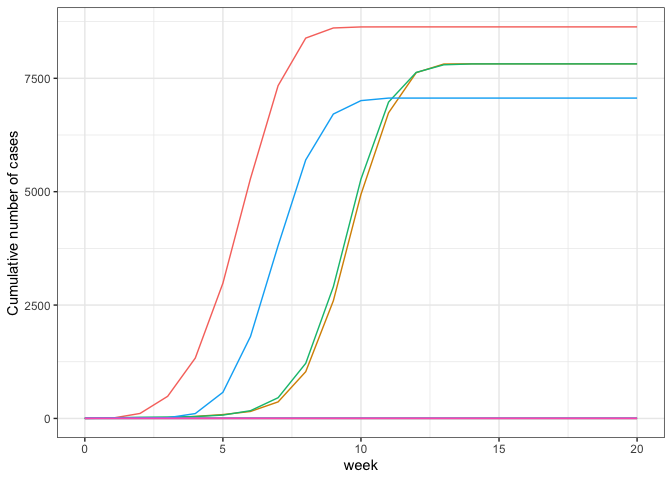
The main functionality of the package is in the scenario_sim() function. Here is an example for running 10 simulations of a given scenario:
library("ringbp")
library("ggplot2")

res <- scenario_sim(
  n = 10, ## 10 simulations
  initial_cases = 1, ## one initial case in each of the simulations
  offspring = offspring_opts(
    ## non-isolated individuals have R0 of 2.5 and a dispersion parameter
    community = \(n) rnbinom(n = n, mu = 2.5, size = 0.16),
    ## isolated individuals have R0 of 0.5 and a dispersion  parameter
    isolated = \(n) rnbinom(n = n, mu = 0.5, size = 1)
    ## by default asymptomatic individuals are assumed to have the same R0
    ## and dispersion as non-isolated individuals
  ),
  delays = delay_opts(
    incubation_period = \(x) stats::rweibull(n = x, shape = 2.322737, scale = 6.492272),
    onset_to_isolation = \(x) stats::rweibull(n = x, shape = 1.651524, scale = 4.287786)
  ),
  event_probs = event_prob_opts(
    ## 10% asymptomatic infections
    asymptomatic = 0.1,
    ## 50% probability of onward infection time being before symptom onset
    presymptomatic_transmission = 0.5,
    ## 20% probability of ascertainment by contact tracing
    symptomatic_traced = 0.2
  ),
  ## whether quarantine is in effect
  interventions = intervention_opts(quarantine = FALSE),
  sim = sim_opts(
    ## don't simulate beyond 140 days
    cap_max_days = 140,
    ## don't simulate beyond 4500 infections
    cap_cases = 4500
  )
)
Plot of weekly cases
ggplot(
  data = res, aes(x = week, y = cumulative, col = as.factor(sim))
) +
  geom_line(show.legend = FALSE) +
  scale_y_continuous(name = "Cumulative number of cases") +
  theme_bw()
Estimate extinction probability
extinct_prob(res)
#> Calculating extinction using the extinction status from the simulation.
#> [1] 0.6
Contribute
Contributions to {ringbp} are welcomed. Please follow the package contributing guide.
Contributors
All contributions to this project are gratefully acknowledged using the allcontributors package following the all-contributors specification. Contributions of any kind are welcome!
Code
seabbs, sbfnk, jhellewell14, timcdlucas, amygimma, joshwlambert, Bisaloo, actions-user
Issue Authors
Issue Contributors
thimotei, adamkucharski, dcadam, jamesmbaazam
Code of Conduct
Please note that the {ringbp} project is released with a Contributor Code of Conduct. By contributing to this project, you agree to abide by its terms.
References
Hellewell, Joel, Sam Abbott, Amy Gimma, Nikos I Bosse, Christopher I Jarvis, Timothy W Russell, James D Munday, et al. 2020. “Feasibility of Controlling COVID-19 Outbreaks by Isolation of Cases and Contacts.” The Lancet Global Health 8 (4): e488–96. https://doi.org/10.1016/s2214-109x(20)30074-7.
Kucharski, Adam J., Rosalind M. Eggo, Conall H. Watson, Anton Camacho, Sebastian Funk, and W. John Edmunds. 2016. “Effectiveness of Ring Vaccination as Control Strategy for Ebola Virus Disease.” Emerging Infectious Diseases 22 (1): 105–8. https://doi.org/10.3201/eid2201.151410.