MyNixOS website logo
Description

Detect Anomalies Using the Spectral Residual Algorithm.

Apply the spectral residual algorithm to data, such as a time series, to detect anomalies. Anomaly scores can be used to determine outliers based upon a threshold or fed into more sophisticated prediction models. Methods are based upon "Time-Series Anomaly Detection Service at Microsoft", Ren, H., Xu, B., Wang, Y., et al., (2019) <doi:10.48550/arXiv.1906.03821>.

spectralAnomaly spectralAnomaly website

CRANstatus CRANchecks R-CMD-check Dependencies Downloads Codecov testcoverage

The {spectralAnomaly} package is a simple set of tools for R users to detect anomalies in data, such as a time series, using the ‘Spectral Residual’ method.

Installation

The {spectralAnomaly} can be installed directly from CRAN:

install.packages('spectralAnomaly')

You can also install the latest development version of {spectralAnomaly} like so:

remotes::install_github('al-obrien/spectralAnomaly')

Examples

library(spectralAnomaly)

Create a noisy time series with a modest anomaly threshold

test_ts <- ts(rnorm(12*6,10,2), start=c(2009, 1), end=c(2014, 12), frequency=12)
ts_scores <- anomaly_score(test_ts, score_window = 25)
plot(test_ts, type = 'l')
points(test_ts, col = ifelse(ts_scores > quantile(ts_scores, prob = 0.95),'red',NA), pch = 16)
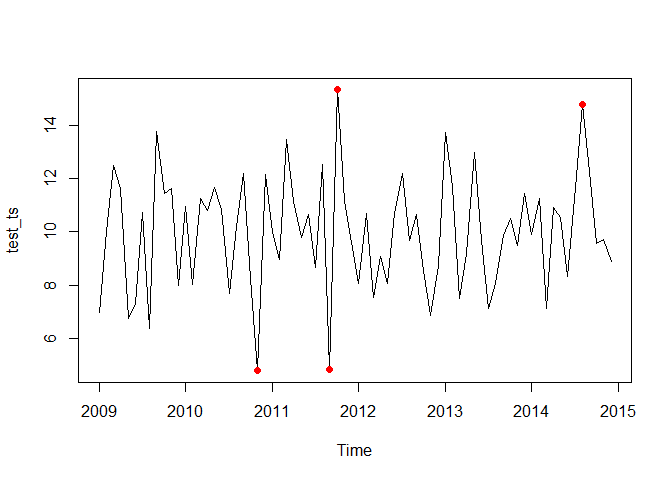
Anomalies in a noisy time series.

Create a series with a step

test_ts_step <- c(rnorm(1, 1, n=250),
                  rnorm(10, 1, n=250))
ts_scores <- anomaly_score(test_ts_step, score_window = 100)
plot(test_ts_step, type = 'l')
points(test_ts_step, col = ifelse(ts_scores > quantile(ts_scores, prob = 0.99),'red',NA), pch = 16)
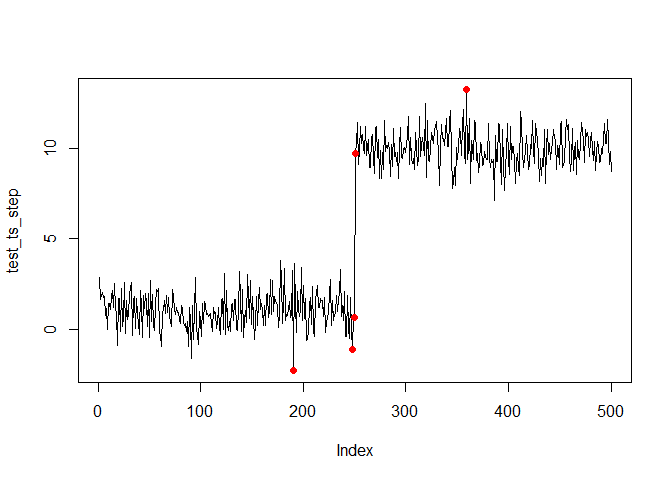
Anomalies in a time series with a breakpoint.

References

  1. Time-Series Anomaly Detection Service at Microsoft
  2. ML-based Anomaly Detection
  3. Saliency Detection
  4. anomalydetector.
Metadata

Version

0.1.1

License

Unknown

Platforms (78)

    Darwin
    FreeBSD
    Genode
    GHCJS
    Linux
    MMIXware
    NetBSD
    none
    OpenBSD
    Redox
    Solaris
    uefi
    WASI
    Windows
Show all
  • aarch64-darwin
  • aarch64-freebsd
  • aarch64-genode
  • aarch64-linux
  • aarch64-netbsd
  • aarch64-none
  • aarch64-uefi
  • aarch64-windows
  • aarch64_be-none
  • arm-none
  • armv5tel-linux
  • armv6l-linux
  • armv6l-netbsd
  • armv6l-none
  • armv7a-linux
  • armv7a-netbsd
  • armv7l-linux
  • armv7l-netbsd
  • avr-none
  • i686-cygwin
  • i686-freebsd
  • i686-genode
  • i686-linux
  • i686-netbsd
  • i686-none
  • i686-openbsd
  • i686-windows
  • javascript-ghcjs
  • loongarch64-linux
  • m68k-linux
  • m68k-netbsd
  • m68k-none
  • microblaze-linux
  • microblaze-none
  • microblazeel-linux
  • microblazeel-none
  • mips-linux
  • mips-none
  • mips64-linux
  • mips64-none
  • mips64el-linux
  • mipsel-linux
  • mipsel-netbsd
  • mmix-mmixware
  • msp430-none
  • or1k-none
  • powerpc-linux
  • powerpc-netbsd
  • powerpc-none
  • powerpc64-linux
  • powerpc64le-linux
  • powerpcle-none
  • riscv32-linux
  • riscv32-netbsd
  • riscv32-none
  • riscv64-linux
  • riscv64-netbsd
  • riscv64-none
  • rx-none
  • s390-linux
  • s390-none
  • s390x-linux
  • s390x-none
  • vc4-none
  • wasm32-wasi
  • wasm64-wasi
  • x86_64-cygwin
  • x86_64-darwin
  • x86_64-freebsd
  • x86_64-genode
  • x86_64-linux
  • x86_64-netbsd
  • x86_64-none
  • x86_64-openbsd
  • x86_64-redox
  • x86_64-solaris
  • x86_64-uefi
  • x86_64-windows