

Dataset Dependency Graphs for Leakage-Aware Evaluation.
splitGraph: Dataset Dependency Graphs for Leakage-Aware Evaluation


splitGraph is an R package for representing biomedical dataset structure as a typed dependency graph so that leakage-relevant relationships can be made explicit, validated, queried, and converted into deterministic split constraints.
It does not fit models, run preprocessing pipelines, or generate resamples by itself. Its job is to encode dataset structure before evaluation so that overlap, provenance, and time-ordering assumptions are inspectable instead of implicit.
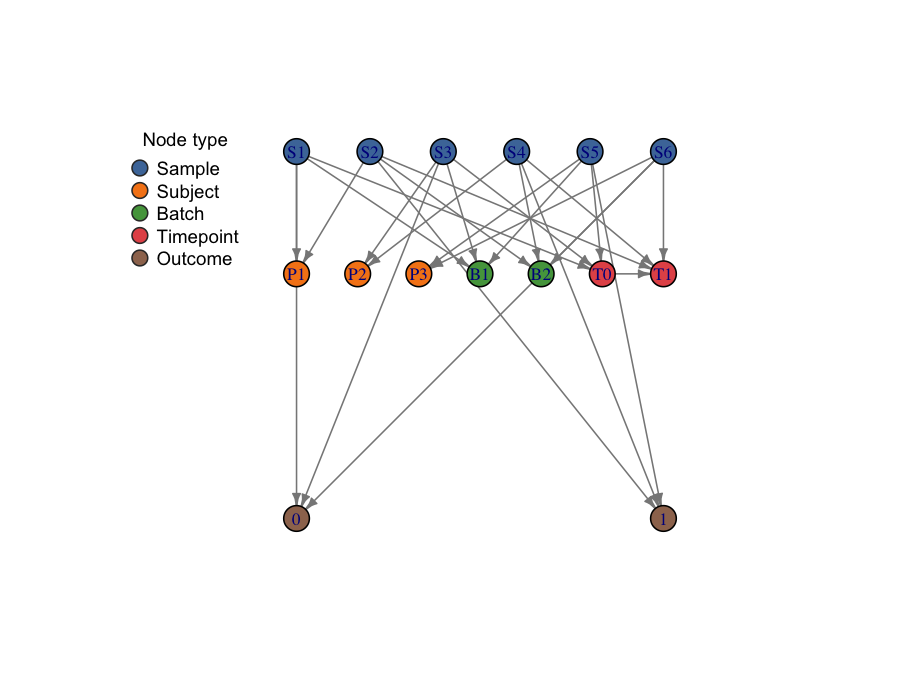
The plot above shows six samples (blue) that share three subjects (orange), two batches (green), two timepoints (red), and two outcome classes (brown). A plain vfold_cv on this dataset would violate subject, batch, and time structure at the same time — and that is exactly what the graph is designed to make visible.
Why It Exists
In biomedical evaluation workflows, leakage often comes from dataset structure rather than obvious coding mistakes. Samples may share:
- the same subject
- the same batch
- the same study
- the same collection timepoint
- the same assay provenance
- the same derived feature set
- the same outcome definition
If those relationships are not modeled explicitly, a train/test split can look correct while still violating the intended scientific separation.
splitGraph makes those dependencies first-class objects.
What It Does (and Does Not Do)
Does:
- metadata ingestion with canonical ID normalization
- one-shot graph construction from canonical metadata via
graph_from_metadata() - typed node and edge constructors backed by
igraph - structural, semantic, and leakage-relevant validation, with a documented
validation_overridesmechanism for explicit exceptions - typed query and traversal helpers (with a safety cap on
query_paths()) - projected sample-dependency detection
- split-constraint derivation for subject, batch, study, time, site, region, platform, assay, relatedness, spatial, and composite modes (the pairwise
relatedness/spatialmodes group by transitive closure over thresholded edges built withrelatedness_edges_from_kinship()/spatial_edges_from_coords()) - translation of constraints into a stable, tool-agnostic
split_spec - split-spec preflight validation and leakage summary helpers
- JSON serialization for
dependency_graphandsplit_specso handoff objects are portable across sessions and languages (write_*()/read_*(), requiresjsonlite) - typed layered
plot()method with per-type colors and a node-type legend print(),summary(), andas.data.frame()on all core S3 objects
Does not:
- fit models or run preprocessing pipelines
- generate resamples (
rsampledoes that) - implement leakage-aware training workflows
- provide a general-purpose graph analytics toolkit
The package is intentionally narrow: dataset dependency structure for leakage-aware evaluation design.
Scope & Relationship to bioLeak
splitGraph sits one layer above execution. It represents dependency structure, validates it, and emits a neutral split_spec — and stops there. It has zero resampling or modeling dependencies and no runtime dependency on any downstream package.
| splitGraph owns | Downstream consumer owns |
|---|---|
| Typed dependency graph + validation | Generating resamples / folds |
| Deriving split constraints | Stratified splitting, purge/embargo execution |
Emitting + validating the split_spec IR | Model fitting, tuning, performance auditing |
| Carrying stratum / ordering / blocking annotations | Statistical leakage evidence (ΔLSI, permutation gaps) |
The reference consumer is bioLeak: bioLeak::as_leaksplits(spec, data, outcome) turns a splitGraph split_spec into an executable, leakage-audited split plan. Because split_spec is a documented, tool-agnostic contract (with a formal JSON Schema and a Python reference consumer), other tools — an rsample adapter, the shipped Python reader driving scikit-learn — can consume it equally. A contract test (Suggests: bioLeak, skipped if absent) pins this seam so neither side breaks it silently.
Installation
From GitHub:
install.packages("remotes")
remotes::install_github("selcukorkmaz/splitGraph")
To use the JSON serialization API, also install jsonlite:
install.packages("jsonlite")
Quick Start
The fastest path is graph_from_metadata(), which auto-detects canonical columns in a metadata frame and assembles a validated dependency_graph:
library(splitGraph)

meta <- data.frame(
  sample_id    = c("S1", "S2", "S3", "S4", "S5", "S6"),
  subject_id   = c("P1", "P1", "P2", "P2", "P3", "P3"),
  batch_id     = c("B1", "B2", "B1", "B2", "B1", "B2"),
  timepoint_id = c("T0", "T1", "T0", "T1", "T0", "T1"),
  time_index   = c(0, 1, 0, 1, 0, 1),
  outcome_id   = c("ctrl", "case", "ctrl", "case", "case", "ctrl")
)

g <- graph_from_metadata(meta, graph_name = "demo")
plot(g)

validation <- validate_graph(g)
subject_constraint <- derive_split_constraints(g, mode = "subject")
spec <- as_split_spec(subject_constraint, graph = g)
validate_split_spec(spec)
summarize_leakage_risks(g, constraint = subject_constraint, split_spec = spec)

# Persist the spec for a downstream consumer (R or non-R):
path <- tempfile(fileext = ".json")
write_split_spec(spec, path)
spec2 <- read_split_spec(path)
For full control over node labels, attribute columns, and the feature-set provenance edges, use create_nodes() / create_edges() / build_dependency_graph() directly. graph_from_metadata() auto-builds the nine sample-rooted canonical edges (including sample_collected_at_site from a site_id column, sample_located_in_region from a region_id column, and sample_run_on_platform from a platform_id column), timepoint_precedes, and the appropriate outcome edge (sample_has_outcome by default, or subject_has_outcome when outcome_scope = "subject"). The featureset_generated_from_study and featureset_generated_from_batch edges always require the explicit constructor path.
Downstream Handoff
split_spec is the tool-agnostic handoff object produced by as_split_spec(). splitGraph does not know about any particular resampling package — downstream consumers are expected to provide their own adapters so that splitGraph stays neutral and has no runtime dependency on them.
The typical end-to-end flow is:
graph_from_metadata(meta)→ typeddependency_graphderive_split_constraints(g, mode = ...)→split_constraintas_split_spec(constraint, graph = g)→split_spec- (optional)
write_split_spec(spec, path)→ JSON, for cross-session or cross-language handoff - adapter in the downstream package → native resamples
The sample_data frame carried by split_spec exposes exactly what an adapter needs: sample_id for joining against the observation frame, group_id for grouped resampling, batch_group / study_group for blocking, and order_rank for ordered evaluation. An adapter can be built on top of, for example, rsample::group_vfold_cv() (grouped CV keyed to group_id) or rsample::rolling_origin() (ordered evaluation keyed to order_rank).
For three small, self-contained adapter examples (a base-R LOGO adapter, plus illustrative rsample::group_vfold_cv() and rsample::rolling_origin() adapters), see the Adapter cookbook vignette:
vignette("adapter-cookbook", package = "splitGraph")
split_spec is a language-neutral interchange format. A pure-Python reference consumer ships in inst/python (splitspec) that reads the JSON and drives scikit-learn GroupKFold / StratifiedGroupKFold / TimeSeriesSplit; a conformance check asserts the Python grouping matches R's grouping_vector(). The cross-language handoff vignette walks the full R → JSON → Python → scikit-learn path:
vignette("cross-language-handoff", package = "splitGraph")
Core Concepts
Node types
Sample,Subject,Batch,Study,Timepoint,Assay,FeatureSet,Outcome,Site,Region,Platform
Canonical edge types
sample_belongs_to_subjectsample_processed_in_batchsample_from_studysample_collected_at_timepointsample_measured_by_assaysample_uses_featuresetsample_has_outcomesubject_has_outcomesample_collected_at_sitesample_located_in_regionsample_run_on_platformassay_uses_platformsubject_related_tosample_adjacent_totimepoint_precedesfeatureset_generated_from_studyfeatureset_generated_from_batch
Main S3 objects
graph_node_set, graph_edge_set, dependency_graph, depgraph_validation_report, graph_query_result, split_constraint, split_spec, split_spec_validation, leakage_risk_summary.
Main Functions
| Layer | Functions |
|---|---|
| Ingestion and construction | ingest_metadata(), graph_from_metadata(), create_nodes(), create_edges(), build_dependency_graph(), dependency_graph(), as_igraph() |
| Validation | validate_graph() (with validation_overrides), validate_split_spec() |
| Queries | query_node_type(), query_edge_type(), query_neighbors(), query_paths() (capped by default), query_shortest_paths(), detect_dependency_components(), detect_shared_dependencies() |
| Constraint derivation | derive_split_constraints(), grouping_vector() |
| Split-spec translation | as_split_spec(), summarize_leakage_risks() |
| Serialization (JSON) | write_dependency_graph(), read_dependency_graph(), write_split_spec(), read_split_spec() |
Example Queries
query_node_type(g, "Subject")
query_edge_type(g, "sample_processed_in_batch")
query_neighbors(g, node_ids = "sample:S1", edge_types = "sample_belongs_to_subject")
detect_shared_dependencies(g, via = "Batch")
detect_dependency_components(g, via = c("Subject", "Batch"))
Example Split Designs
subject_constraint <- derive_split_constraints(g, mode = "subject")
batch_constraint   <- derive_split_constraints(g, mode = "batch")
study_constraint   <- derive_split_constraints(g, mode = "study")
time_constraint    <- derive_split_constraints(g, mode = "time")
site_constraint    <- derive_split_constraints(g, mode = "site")
region_constraint  <- derive_split_constraints(g, mode = "region")
platform_constraint <- derive_split_constraints(g, mode = "platform")
assay_constraint   <- derive_split_constraints(g, mode = "assay")

strict_composite <- derive_split_constraints(
  g, mode = "composite", strategy = "strict",
  via = c("Subject", "Batch")
)

rule_based_composite <- derive_split_constraints(
  g, mode = "composite", strategy = "rule_based",
  priority = c("batch", "study", "subject", "time")
)
Pairwise (thresholded) relations are built from a continuous similarity signal and then grouped by transitive closure over the surviving edges:
# Genetic relatedness: keep subject pairs with kinship >= 0.1.
kin <- data.frame(id1 = "P1", id2 = "P2", kinship = 0.25)
rel_edges <- relatedness_edges_from_kinship(kin, threshold = 0.1)

# Spatial proximity: connect samples within a radius.
coords <- data.frame(sample_id = c("S1", "S2", "S3"), x = c(0, 1, 9), y = c(0, 1, 9))
adj_edges <- spatial_edges_from_coords(coords, radius = 2)

# Combine with the base node/edge sets in build_dependency_graph(), then:
relatedness_constraint <- derive_split_constraints(g, mode = "relatedness")
spatial_constraint     <- derive_split_constraints(g, mode = "spatial")
Serialization (JSON)
Both core handoff objects can be written to a stable, schema-versioned JSON format and read back, so a dependency_graph or split_spec is portable across R sessions and across language boundaries.
graph_path <- tempfile(fileext = ".json")
spec_path  <- tempfile(fileext = ".json")

write_dependency_graph(g, graph_path)
write_split_spec(spec, spec_path)

g2    <- read_dependency_graph(graph_path)
spec2 <- read_split_spec(spec_path)
Both formats have a formal JSON Schema (Draft 2020-12) shipped in inst/schema/, and every written file references it via a $schema key. Validate a handoff file against the contract with validate_graph_json() / validate_split_spec_json(). Each file also carries a schema_version; the major version is the compatibility boundary, so files sharing the installed major load silently while a differing major warns. migrate_dependency_graph_json() / migrate_split_spec_json() upgrade an older file to the current version in place. NA values in sample_data round-trip as JSON null. The jsonlite package (a Suggests dep) must be installed.
Plot Method
plot(g) renders a typed, layered layout with per-type node colors and an auto-generated node-type legend. Layers: Sample (top), peer dependencies (Subject / Batch / Study / Timepoint) in the middle band, Assay / FeatureSet next, Outcome (bottom).
plot(g)                              # typed layered layout (default)
plot(g, layout = "sugiyama")         # alternative hierarchical layout
plot(g, show_labels = FALSE)         # hide node labels on dense graphs
plot(g, legend = FALSE)              # suppress the legend
plot(g, legend_position = "bottomright")
plot(g, node_colors = c(Sample = "#000000"))  # override type colors
Citation
citation("splitGraph")
produces:
Korkmaz S (2026). splitGraph: Dataset Dependency Graphs for Leakage-Aware Evaluation. R package version 0.2.0. https://github.com/selcukorkmaz/splitGraph
License
MIT. See LICENSE.
Appendix: Design Guarantees
The package prefers explicit failure over silent guessing. In particular:
- unknown sample IDs, ambiguous direct assignments, and conflicting duplicate nodes or edges are rejected rather than silently resolved
- contradictory time-order metadata are rejected rather than reconciled arbitrarily
- validation truth is not changed by severity filters, and generated split specs are re-validated against the package's own preflight rules
- documented exceptions go through
validation_overrides(e.g.allow_multi_subject_samples); the same override is honored by bothvalidate_graph()andderive_split_constraints(mode = "subject") query_paths()defaults to a finite path-length cap so traversal cannot explode on dense graphs; passmax_length = Infto opt out- the on-disk JSON format is schema-versioned, and loading a file with a different
schema_versionwarns rather than failing silently.