

Description
Interpretable Survival Machine Learning Framework.
Description
A modular toolkit for interpretable survival machine learning with a unified interface for fitting, prediction, evaluation, and interpretation. It includes semiparametric, parametric, tree-based, ensemble, boosting, kernel, and deep-learning survival learners, together with benchmarking, scoring, calibration, and model-agnostic interpretation utilities. Representative methodological anchors include Cox (1972) <doi:10.1111/j.2517-6161.1972.tb00899.x>, Royston and Parmar (2002) <doi:10.1002/sim.1203>, Ishwaran et al. (2008) <doi:10.1214/08-AOAS169>, Jaeger et al. (2019) <doi:10.1214/19-AOAS1261>, Harrell et al. (1982) <doi:10.1001/jama.1982.03320430047030>, Graf et al. (1999) <doi:10.1002/(SICI)1097-0258(19990915/30)18:17/18%3C2529::AID-SIM274%3E3.0.CO;2-5>, Friedman (2001) <doi:10.1214/aos/1013203451>, Apley and Zhu (2020) <doi:10.1111/rssb.12377>, and Lundberg and Lee (2017) <https://papers.nips.cc/paper/7062-a-unified-approach-to-interpreting-model-predictions>, and other related methods for survival modeling, prediction, and interpretation.
README.md
Survalis: Unified Survival Machine Learning and Interpretability in R
survalis provides a unified framework for survival machine learning survival analysis in R. It supports a wide range of learners, evaluation metrics, cross-validation and interpretability methods.
Installation
# Install from GitHub
remotes::install_github("ielbadisy/survalis")

# Or from source
install.packages("survalis_0.7.0.tar.gz", repos = NULL, type = "source")
Core philosophy
- Consistent function patterns:
fit_*(),predict_*(),tune_*() - Learners return standardized
mlsurv_modelobjects - Predictions return
data.frameof survival probabilities:t=100,t=200, … - Evaluation is fully modular: plug any
fit_*/predict_*withcv_survlearner()orscore_survmodel() - Designed for interpretability post prediction.
Exploring the package
List all available survival learners
library(survalis)
# See all available learners
list_survlearners()
#> # A tibble: 19 × 8
#>    learner         fit      predict tune  has_fit has_predict has_tune available
#>    <chr>           <chr>    <chr>   <chr> <lgl>   <lgl>       <lgl>    <lgl>
#>  1 coxph           fit_cox… predic… <NA>  TRUE    TRUE        FALSE    TRUE
#>  2 aalen           fit_aal… predic… <NA>  TRUE    TRUE        FALSE    TRUE
#>  3 glmnet          fit_glm… predic… tune… TRUE    TRUE        TRUE     TRUE
#>  4 selectcox       fit_sel… predic… tune… TRUE    TRUE        TRUE     TRUE
#>  5 aftgee          fit_aft… predic… <NA>  TRUE    TRUE        FALSE    TRUE
#>  6 flexsurvreg     fit_fle… predic… tune… TRUE    TRUE        TRUE     TRUE
#>  7 stpm2           fit_stp… predic… <NA>  TRUE    TRUE        FALSE    TRUE
#>  8 bnnsurv         fit_bnn… predic… tune… TRUE    TRUE        TRUE     TRUE
#>  9 rpart           fit_rpa… predic… tune… TRUE    TRUE        TRUE     TRUE
#> 10 bart            fit_bart predic… tune… TRUE    TRUE        TRUE     TRUE
#> 11 xgboost         fit_xgb… predic… tune… TRUE    TRUE        TRUE     TRUE
#> 12 ranger          fit_ran… predic… tune… TRUE    TRUE        TRUE     TRUE
#> 13 rsf             fit_rsf  predic… tune… TRUE    TRUE        TRUE     TRUE
#> 14 cforest         fit_cfo… predic… tune… TRUE    TRUE        TRUE     TRUE
#> 15 blackboost      fit_bla… predic… tune… TRUE    TRUE        TRUE     TRUE
#> 16 survsvm         fit_sur… predic… tune… TRUE    TRUE        TRUE     TRUE
#> 17 survdnn         fit_sur… predic… tune… TRUE    TRUE        TRUE     TRUE
#> 18 orsf            fit_orsf predic… tune… TRUE    TRUE        TRUE     TRUE
#> 19 survmetalearner fit_sur… predic… <NA>  TRUE    TRUE        FALSE    TRUE

# See only tunable learners (those with a tune_* function)
list_survlearners(has_tune = TRUE)
#> # A tibble: 14 × 8
#>    learner     fit          predict tune  has_fit has_predict has_tune available
#>    <chr>       <chr>        <chr>   <chr> <lgl>   <lgl>       <lgl>    <lgl>
#>  1 glmnet      fit_glmnet   predic… tune… TRUE    TRUE        TRUE     TRUE
#>  2 selectcox   fit_selectc… predic… tune… TRUE    TRUE        TRUE     TRUE
#>  3 flexsurvreg fit_flexsur… predic… tune… TRUE    TRUE        TRUE     TRUE
#>  4 bnnsurv     fit_bnnsurv  predic… tune… TRUE    TRUE        TRUE     TRUE
#>  5 rpart       fit_rpart    predic… tune… TRUE    TRUE        TRUE     TRUE
#>  6 bart        fit_bart     predic… tune… TRUE    TRUE        TRUE     TRUE
#>  7 xgboost     fit_xgboost  predic… tune… TRUE    TRUE        TRUE     TRUE
#>  8 ranger      fit_ranger   predic… tune… TRUE    TRUE        TRUE     TRUE
#>  9 rsf         fit_rsf      predic… tune… TRUE    TRUE        TRUE     TRUE
#> 10 cforest     fit_cforest  predic… tune… TRUE    TRUE        TRUE     TRUE
#> 11 blackboost  fit_blackbo… predic… tune… TRUE    TRUE        TRUE     TRUE
#> 12 survsvm     fit_survsvm  predic… tune… TRUE    TRUE        TRUE     TRUE
#> 13 survdnn     fit_survdnn  predic… tune… TRUE    TRUE        TRUE     TRUE
#> 14 orsf        fit_orsf     predic… tune… TRUE    TRUE        TRUE     TRUE

# Shortcut for tunable learners
list_tunable_survlearners()
#> # A tibble: 14 × 8
#>    learner     fit          predict tune  has_fit has_predict has_tune available
#>    <chr>       <chr>        <chr>   <chr> <lgl>   <lgl>       <lgl>    <lgl>
#>  1 glmnet      fit_glmnet   predic… tune… TRUE    TRUE        TRUE     TRUE
#>  2 selectcox   fit_selectc… predic… tune… TRUE    TRUE        TRUE     TRUE
#>  3 flexsurvreg fit_flexsur… predic… tune… TRUE    TRUE        TRUE     TRUE
#>  4 bnnsurv     fit_bnnsurv  predic… tune… TRUE    TRUE        TRUE     TRUE
#>  5 rpart       fit_rpart    predic… tune… TRUE    TRUE        TRUE     TRUE
#>  6 bart        fit_bart     predic… tune… TRUE    TRUE        TRUE     TRUE
#>  7 xgboost     fit_xgboost  predic… tune… TRUE    TRUE        TRUE     TRUE
#>  8 ranger      fit_ranger   predic… tune… TRUE    TRUE        TRUE     TRUE
#>  9 rsf         fit_rsf      predic… tune… TRUE    TRUE        TRUE     TRUE
#> 10 cforest     fit_cforest  predic… tune… TRUE    TRUE        TRUE     TRUE
#> 11 blackboost  fit_blackbo… predic… tune… TRUE    TRUE        TRUE     TRUE
#> 12 survsvm     fit_survsvm  predic… tune… TRUE    TRUE        TRUE     TRUE
#> 13 survdnn     fit_survdnn  predic… tune… TRUE    TRUE        TRUE     TRUE
#> 14 orsf        fit_orsf     predic… tune… TRUE    TRUE        TRUE     TRUE
List interpretability tools
# List available interpretability methods
list_interpretability_methods()
#> # A tibble: 8 × 4
#>   compute                plot                has_compute has_plot
#>   <chr>                  <chr>               <lgl>       <lgl>
#> 1 compute_shap           plot_shap           TRUE        TRUE
#> 2 compute_pdp            plot_pdp            TRUE        TRUE
#> 3 compute_ale            plot_ale            TRUE        TRUE
#> 4 compute_surrogate      plot_surrogate      TRUE        TRUE
#> 5 compute_tree_surrogate plot_tree_surrogate TRUE        TRUE
#> 6 compute_varimp         plot_varimp         TRUE        TRUE
#> 7 compute_interactions   plot_interactions   TRUE        TRUE
#> 8 compute_counterfactual <NA>                TRUE        FALSE

# Show which compute_* methods have a plot_* counterpart
subset(list_interpretability_methods(), !is.na(plot))
#> # A tibble: 7 × 4
#>   compute                plot                has_compute has_plot
#>   <chr>                  <chr>               <lgl>       <lgl>
#> 1 compute_shap           plot_shap           TRUE        TRUE
#> 2 compute_pdp            plot_pdp            TRUE        TRUE
#> 3 compute_ale            plot_ale            TRUE        TRUE
#> 4 compute_surrogate      plot_surrogate      TRUE        TRUE
#> 5 compute_tree_surrogate plot_tree_surrogate TRUE        TRUE
#> 6 compute_varimp         plot_varimp         TRUE        TRUE
#> 7 compute_interactions   plot_interactions   TRUE        TRUE
List evaluation metrics
# List available metrics used in cross-validation and scoring
list_metrics()
#> # A tibble: 3 × 4
#>   metric direction summary                                                 range
#>   <chr>  <chr>     <chr>                                                   <chr>
#> 1 cindex maximize  Harrell-style concordance index for survival predictio… [0, …
#> 2 brier  minimize  Brier Score at specified evaluation time(s) (IPCW-weig… [0, …
#> 3 ibs    minimize  Integrated Brier Score over an evaluation time grid (I… [0, …
Basic Workflow
1. Fit a model
mod_cox <- fit_coxph(Surv(time, status) ~ age + karno + celltype, data = veteran)
summary(mod_cox)
#>
#> ── coxph summary ───────────────────────────────────────────────────────────────
#> Formula:
#> Surv(time, status) ~ age + karno + celltype
#> Engine: survival
#> Learner: coxph
#> Data summary:
#> - Observations: 137
#> - Predictors: "age, karno, celltypesmallcell, celltypeadeno, celltypelarge"
#> - Time range: [1, 999]
#> - Event rate: "93.4%"
2. Predict survival probabilities
pred <- predict_coxph(mod_cox, newdata = veteran[1:5, ], times = c(100, 200))
pred
#>       t=100     t=200
#> 1 0.6142681 0.3541697
#> 2 0.6944383 0.4599242
#> 3 0.5556797 0.2860796
#> 4 0.6033305 0.3408724
#> 5 0.6959633 0.4620783
3. Evaluate model performance
Direct evalution (single split):
score <- score_survmodel(mod_cox, times = c(100, 200), metrics = c("cindex", "ibs"))
score
#> # A tibble: 2 × 2
#>   metric value
#>   <chr>  <dbl>
#> 1 cindex 0.734
#> 2 ibs    0.160
cv_res <- cv_survlearner(
  Surv(time, status) ~ age + karno + celltype,
  veteran,
  fit_coxph,
  predict_coxph,
  times  = 80,
  metrics = c("cindex", "ibs"),
  folds = 5,
  seed = 123,
  verbose = FALSE
  )

cv_res
#> # A tibble: 10 × 5
#>    splits           id     fold metric value
#>    <list>           <chr> <int> <chr>  <dbl>
#>  1 <split [109/28]> Fold1     1 cindex 0.699
#>  2 <split [109/28]> Fold1     1 ibs    0.227
#>  3 <split [109/28]> Fold2     2 cindex 0.812
#>  4 <split [109/28]> Fold2     2 ibs    0.141
#>  5 <split [110/27]> Fold3     3 cindex 0.695
#>  6 <split [110/27]> Fold3     3 ibs    0.217
#>  7 <split [110/27]> Fold4     4 cindex 0.698
#>  8 <split [110/27]> Fold4     4 ibs    0.188
#>  9 <split [110/27]> Fold5     5 cindex 0.688
#> 10 <split [110/27]> Fold5     5 ibs    0.138
cv_summary(cv_res)
#> # A tibble: 2 × 7
#>   metric  mean     sd     n     se lower upper
#>   <chr>  <dbl>  <dbl> <int>  <dbl> <dbl> <dbl>
#> 1 cindex 0.718 0.0528     5 0.0236 0.672 0.765
#> 2 ibs    0.182 0.0417     5 0.0186 0.146 0.219
4. Visualize interpretation
shap_meanabs <- compute_shap(
  model         = mod_cox,
  newdata       = veteran[100,],
  baseline_data = veteran,
  times         = 80,
  sample.size   = 50,
  aggregate     = TRUE,
  method        = "meanabs"
  )

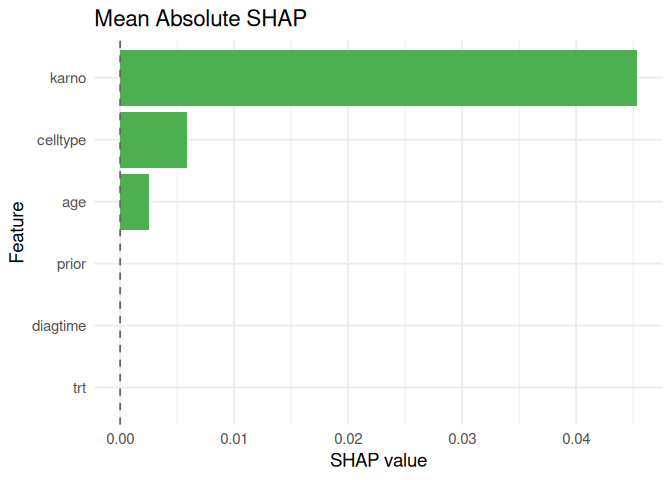
shap_meanabs
#>           feature         phi
#> trt           trt 0.000000000
#> celltype celltype 0.005850095
#> karno       karno 0.045326970
#> diagtime diagtime 0.000000000
#> age           age 0.002540069
#> prior       prior 0.000000000
plot_shap(shap_meanabs)
More interpretability methods
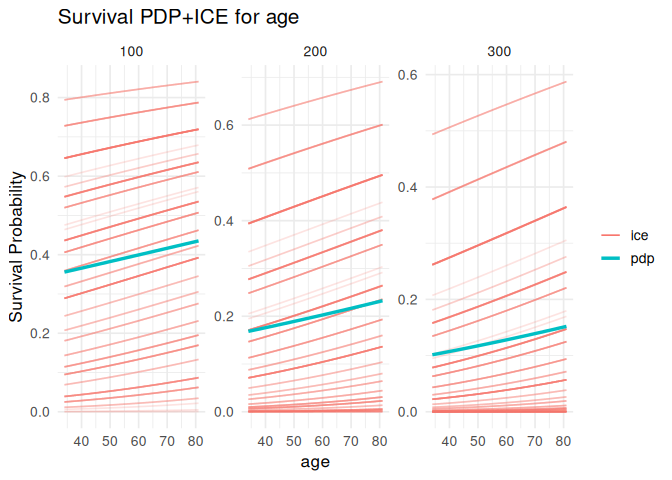
survalis also provides PDP, ALE, surrogate explanations, tree surrogates, permutation importance, interaction analysis, and counterfactuals.
Partial dependence and ICE
pdp_age <- compute_pdp(
  model = mod_cox,
  data = veteran,
  feature = "age",
  times = c(100, 200, 300),
  method = "pdp+ice"
  )

plot_pdp(pdp_age, feature = "age", which = "per_time")
#> Warning: `aes_string()` was deprecated in ggplot2 3.0.0.
#> ℹ Please use tidy evaluation idioms with `aes()`.
#> ℹ See also `vignette("ggplot2-in-packages")` for more information.
#> ℹ The deprecated feature was likely used in the survalis package.
#>   Please report the issue to the authors.
#> This warning is displayed once per session.
#> Call `lifecycle::last_lifecycle_warnings()` to see where this warning was
#> generated.
#> Warning: Using `size` aesthetic for lines was deprecated in ggplot2 3.4.0.
#> ℹ Please use `linewidth` instead.
#> ℹ The deprecated feature was likely used in the survalis package.
#>   Please report the issue to the authors.
#> This warning is displayed once per session.
#> Call `lifecycle::last_lifecycle_warnings()` to see where this warning was
#> generated.
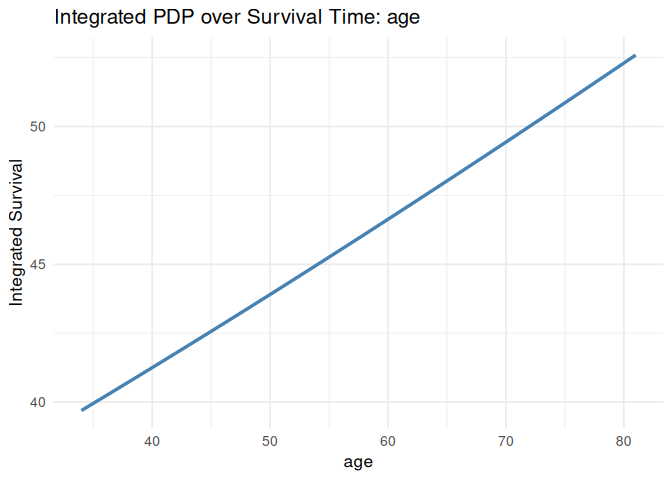
plot_pdp(pdp_age, feature = "age", which = "integrated", smooth = TRUE)
#> `geom_smooth()` using formula = 'y ~ x'
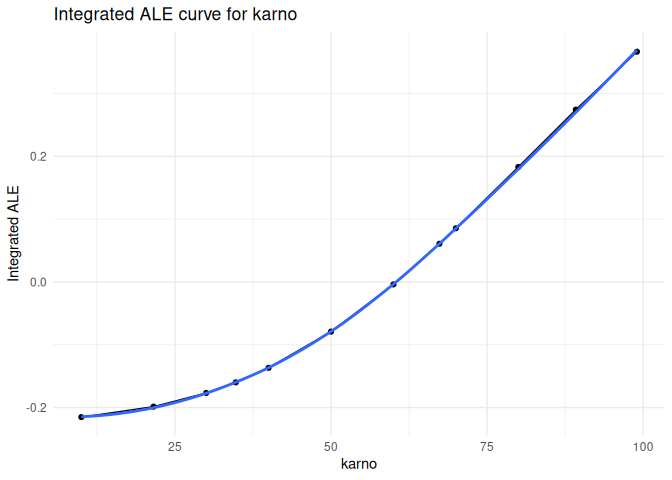
Accumulated local effects
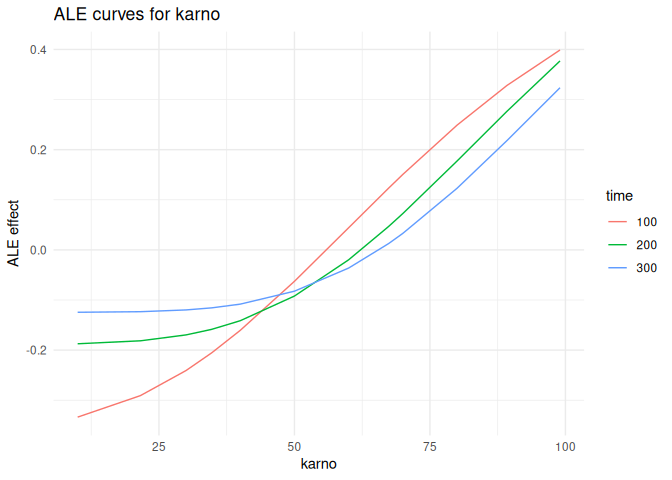
ale_karno <- compute_ale(
  model = mod_cox,
  newdata = veteran,
  feature = "karno",
  times = c(100, 200, 300)
  )

plot_ale(ale_karno, feature = "karno", which = "per_time")
plot_ale(ale_karno, feature = "karno", which = "integrated", smooth = TRUE)
#> `geom_smooth()` using formula = 'y ~ x'
Local surrogate explanation
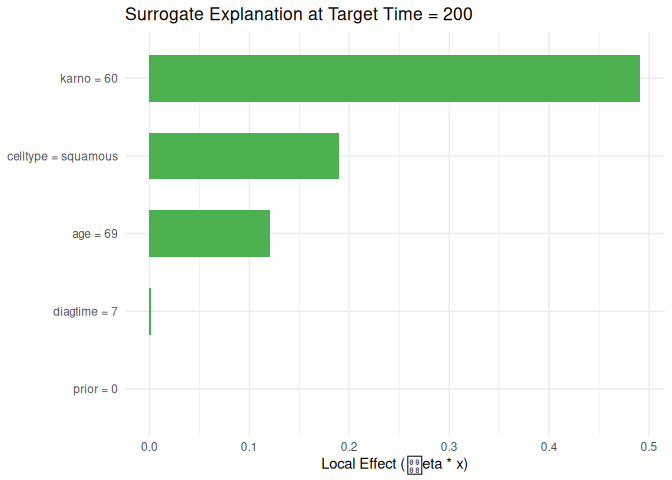
local_surrogate <- compute_surrogate(
  model = mod_cox,
  newdata = veteran[1, , drop = FALSE],
  baseline_data = veteran,
  times = c(100, 200, 300),
  target_time = 200,
  k = 5
  )

local_surrogate
#>    feature feature_value      effect target_time
#> 1    karno            60 0.491034890         200
#> 2 celltype      squamous 0.189632633         200
#> 3      age            69 0.120729843         200
#> 4 diagtime             7 0.001800378         200
#> 5    prior             0 0.000000000         200
plot_surrogate(local_surrogate, top_n = 10)
Tree surrogate
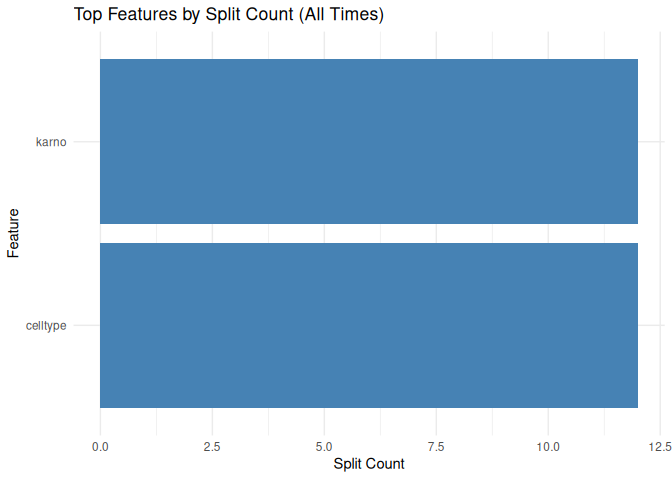
tree_surrogate <- compute_tree_surrogate(
  model = mod_cox,
  data = veteran,
  times = c(100, 200, 300)
  )

plot_tree_surrogate(tree_surrogate, type = "importance", top_n = 5)
# plot_tree_surrogate(tree_surrogate, type = "tree")
Permutation variable importance
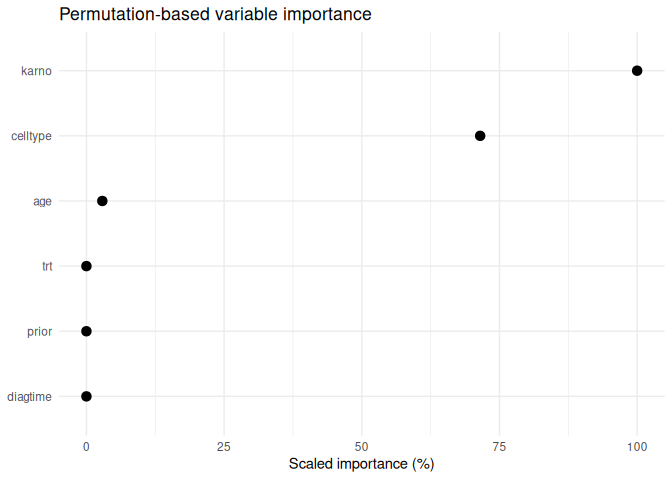
varimp_res <- compute_varimp(
  model = mod_cox,
  times = c(100, 200, 300),
  metric = "ibs",
  n_repetitions = 5,
  seed = 123
  )

varimp_res
#> # A tibble: 6 × 5
#>   feature  importance importance_05 importance_95 scaled_importance
#>   <chr>         <dbl>         <dbl>         <dbl>             <dbl>
#> 1 karno       0.0624          0.192         0.223            100
#> 2 celltype    0.0446          0.185         0.201             71.5
#> 3 age        -0.00180         0.144         0.146              2.89
#> 4 trt         0               0.147         0.147              0
#> 5 diagtime    0               0.147         0.147              0
#> 6 prior       0               0.147         0.147              0
plot_varimp(varimp_res)
Feature interactions
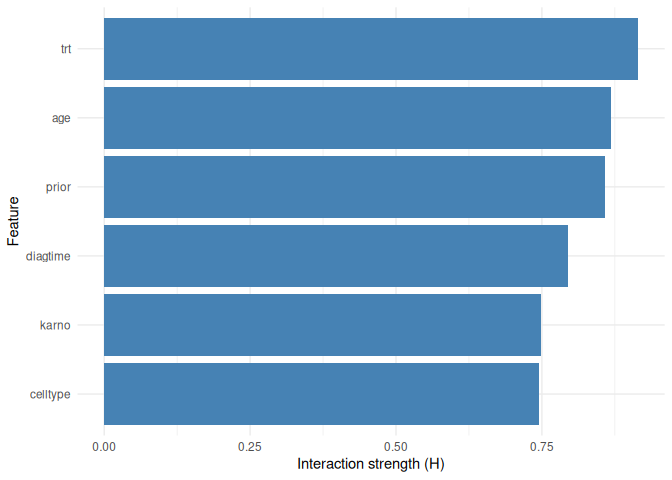
interaction_1way <- compute_interactions(
  model = mod_cox,
  data = veteran,
  times = c(100, 200, 300),
  target_time = 200,
  type = "1way"
  )

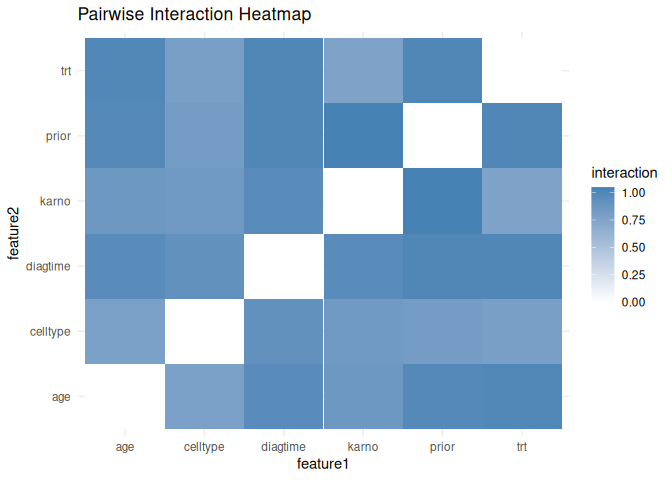
interaction_heatmap <- compute_interactions(
  model = mod_cox,
  data = veteran,
  times = c(100, 200, 300),
  target_time = 200,
  type = "heatmap"
  )

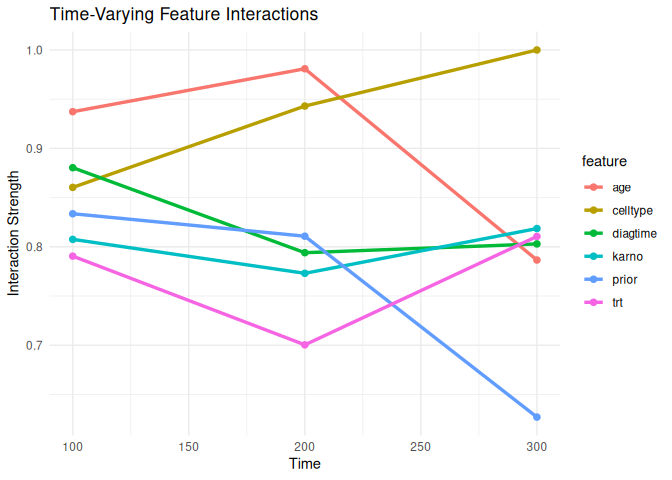
interaction_time <- compute_interactions(
  model = mod_cox,
  data = veteran,
  times = c(100, 200, 300),
  type = "time"
  )

plot_interactions(interaction_1way, type = "1way")
plot_interactions(interaction_heatmap, type = "heatmap")
plot_interactions(interaction_time, type = "time")
Counterfactual explanations
counterfactuals <- compute_counterfactual(
  model = mod_cox,
  newdata = veteran[1, , drop = FALSE],
  times = c(100, 200, 300),
  target_time = 200,
  features_to_change = c("age", "karno", "diagtime"),
  cost_penalty = 0.01
  )

counterfactuals
#>    feature original_value suggested_value survival_gain change_cost
#> 1    karno             60         81.0202        0.2347     21.0202
#> 2 diagtime              7          7.0808        0.0000      0.0808
#> 3      age             69         69.1313        0.0003      0.1313
#>   penalized_gain
#> 1         0.0245
#> 2        -0.0008
#> 3        -0.0010
5. Calibration
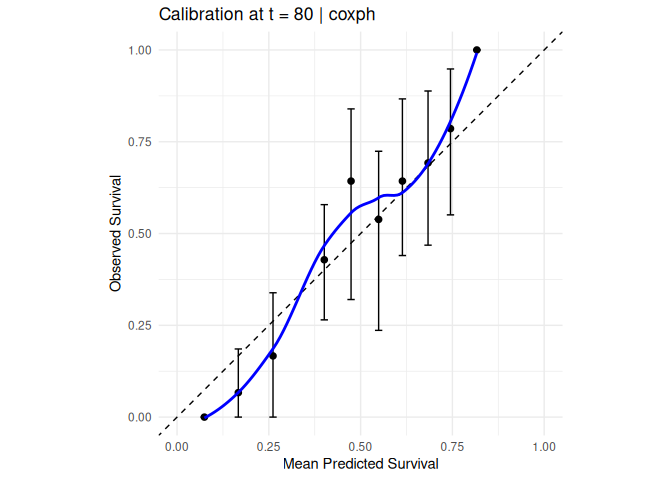
compute_calibration(
   model = mod_cox, data = veteran,
   time = "time", status = "status",
   eval_time = 80, n_bins = 10, n_boot = 30
   ) |> plot_calibration()
Citing
citation("survalis")