

Prior-Data Fitted Network Foundational Model for Tabular Data.
tabpfn


tabpfn, meaning prior fitted networks for tabular data, is a deep-learning model. See:
- Transformers Can Do Bayesian Inference (arXiv, 2021)
- TabPFN: A Transformer That Solves Small Tabular Classification Problems in a Second (arXiv, 2022)
- Accurate predictions on small data with a tabular foundation model (Nature, 2025)
This R package is a wrapper of the Python library via reticulate. It has an idiomatic R syntax using standard S3 methods.
Installation
You can download the package from CRAN via:
install.packages("tabpfn")
or you can install the development version of tabpfn like so:
require(pak)
pak(c("tidymodels/tabpfn"), ask = FALSE)
You’ll need a Python virtual environment to access the underlying library. After installing the R package, tabpfn will install the required Python bits when you first fit a model:
> library(tabpfn)
>
> predictors <- mtcars[, -1]
> outcome <- mtcars[, 1]
>
> # XY interface
> mod <- tab_pfn(predictors, outcome)
Downloading uv...Done!
Downloading cpython-3.12.12 (download) (15.9MiB)
 Downloading cpython-3.12.12 (download)
Downloading setuptools (1.1MiB)
Downloading scikit-learn (8.2MiB)
Downloading numpy (4.9MiB)

<downloading and installing more packages>

 Downloading llvmlite
 Downloading torch
Installed 58 packages in 350ms
> mod
tabpfn Regression Model

Training set
i 32 data points
i 10 predictors
Example
After loading the package:
library(tabpfn)
we can fit a model via the standard x/y interface.
set.seed(364)
reg_mod <- tab_pfn(mtcars[1:25, -1], mtcars$mpg[1:25])
reg_mod
#> TabPFN Regression Model
#> Training set
#> ℹ 25 data points
#> ℹ 10 predictors
There are also formula and recipes interfaces.
Prediction follows the usual S3 predict() method:
predict(reg_mod, mtcars[26:32, -1])
#> # A tibble: 7 × 1
#>   .pred
#>   <dbl>
#> 1  31.4
#> 2  24.3
#> 3  24.8
#> 4  16.4
#> 5  18.9
#> 6  14.4
#> 7  22.5
tabpfn follows the tidymodels prediction convention: a data frame is always returned with a standard set of column names.
For a classification model, the outcome should always be a factor vector. For example, using these data from the modeldata package:
library(modeldata)
#>
#> Attaching package: 'modeldata'
#> The following object is masked from 'package:datasets':
#>
#>     penguins
library(ggplot2)

two_cls_train <- parabolic[1:400,  ]
two_cls_val   <- parabolic[401:500,]
grid <- expand.grid(X1 = seq(-5.1, 5.0, length.out = 25),
                    X2 = seq(-5.5, 4.0, length.out = 25))

set.seed(3824)
cls_mod <- tab_pfn(class ~ ., data = two_cls_train)

grid_pred <- predict(cls_mod, grid)
grid_pred
#> # A tibble: 625 × 3
#>    .pred_Class1 .pred_Class2 .pred_class
#>           <dbl>        <dbl> <fct>
#>  1        0.997      0.00273 Class1
#>  2        0.998      0.00217 Class1
#>  3        0.998      0.00182 Class1
#>  4        0.998      0.00155 Class1
#>  5        0.998      0.00167 Class1
#>  6        0.998      0.00222 Class1
#>  7        0.996      0.00438 Class1
#>  8        0.989      0.0109  Class1
#>  9        0.948      0.0522  Class1
#> 10        0.745      0.255   Class1
#> # ℹ 615 more rows
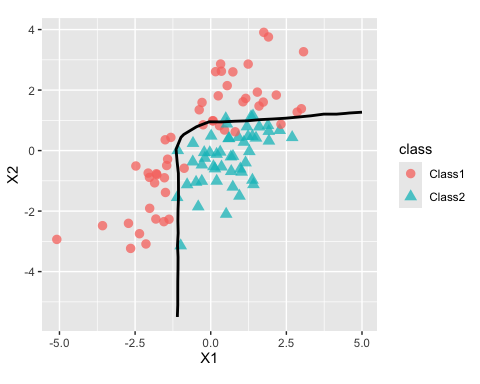
The fit looks fairly good when shown with out-of-sample data:
cbind(grid, grid_pred) |>
  ggplot(aes(X1, X2)) +
  geom_point(
    data = two_cls_val,
    aes(col = class, pch = class),
    alpha = 3 / 4,
    cex = 3
  ) +
  geom_contour(
    aes(z = .pred_Class1),
    breaks = 1 / 2,
    col = "black",
    linewidth = 1
  ) +
  coord_equal(ratio = 1)
License
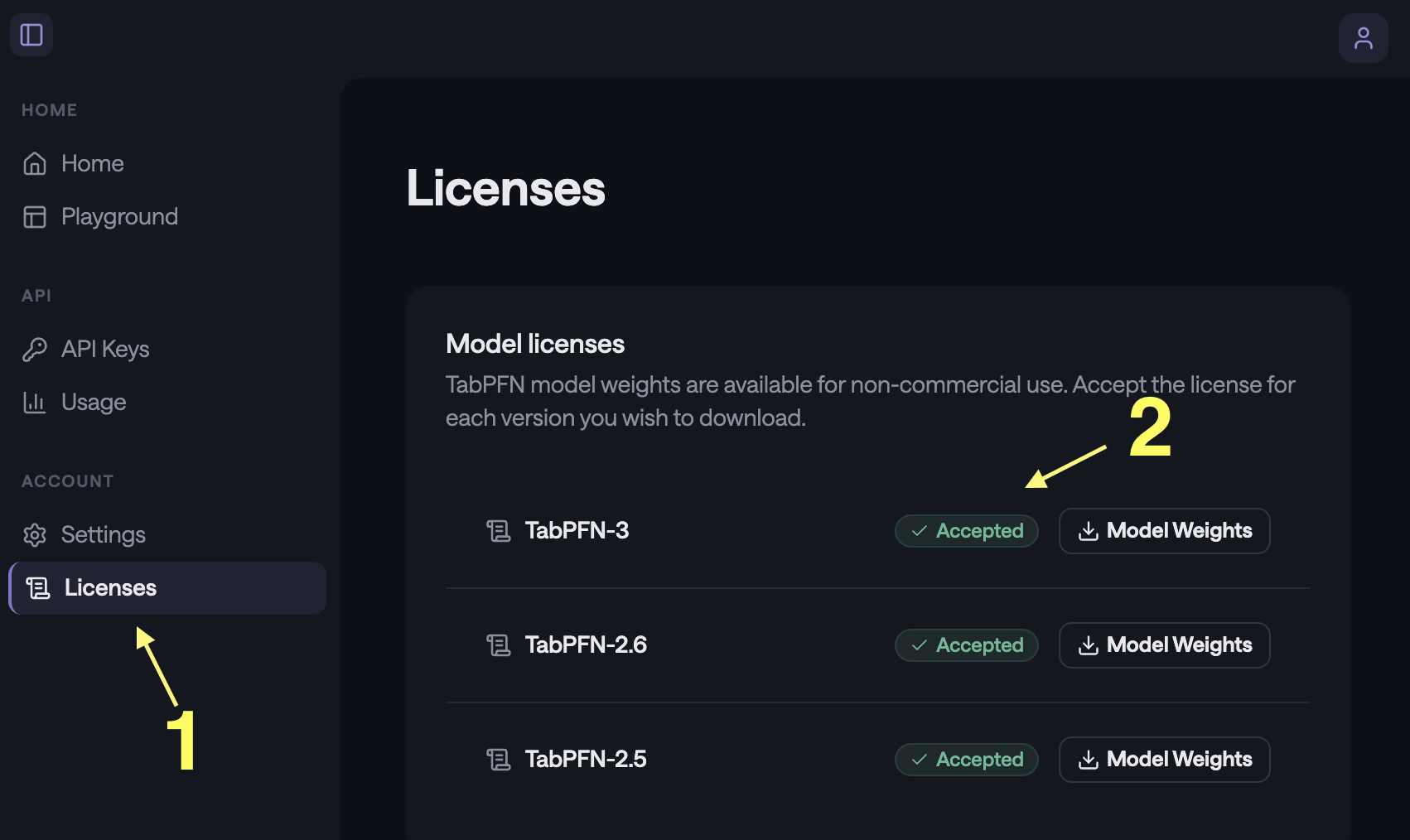
PriorLabs created the model. Starting with version 2.5, using TabPFN requires accepting the model license and setting a token. Each model version (v2.5, v2.6, etc.) has its own license that must be accepted individually.
To get access, visit https://ux.priorlabs.ai, go to the Licenses tab (1), and accept the license for each model version you intend to use (2). Then set the TABPFN_TOKEN environment variable with the token from your account. Users who already have TABPFN_TOKEN set can use TabPFN v2 without any additional steps.
Also, the model is most effective when a GPU is available (by an order of magnitude or two). This may seem obvious to anyone already working with deep learning models, but it is a fairly new requirement for those strictly working with traditional tabular data models.
Code of Conduct
Please note that the tabpfn project is released with a Contributor Code of Conduct. By contributing to this project, you agree to abide by its terms.