

Extract Trends from Time Series.
trendseries
The goal of trendseries is to provide a modern, pipe-friendly interface for exploratory analysis of time series data in conventional data.frame format.
Installation
trendseries is available on CRAN
install.packages("trendseries")
You can install the development version of trendseries from GitHub.
# install.packages("remotes")
remotes::install_github("viniciusoike/trendseries")
Main Functions
The package provides two main functions:
augment_trends(): adds trend columns to tibbles/data.frames.extract_trends(): extracts trends from ts/xts/zoo objects.
Examples
Time series have a specific structure in R (ts) and most filtering methods are designed for ts objects. However, datasets come as data frames with date columns, which can make applying filters cumbersome.
The usual workflow involves (1) converting individual columns to ts, (2) applying the filter, (3) and then converting back to a data.frame. This can be cumbersome, especially when working with multiple series or grouped data. Merging back the results with the original data can also be error-prone due to misalignment of dates and additional NA values introduced by some filters.
trendseries aims to make this process easier by keeping the data in a data.frame format. The example below computes three filters (HP, STL, and moving average) on a quarterly index of construction activity. Note that the augment_trends() function automatically detects the frequency of the data and uses conventional defaults for the HP filter.
library(trendseries)
library(ggplot2)
data("gdp_construction")
# Computes multiple trends at once
series <- gdp_construction |>
  # Automatically detects frequency
  # Trends are added as new columns to the original dataset
  augment_trends(
    value_col = "index",
    methods = c("hp", "stl", "ma")
  )
#> Auto-detected quarterly (4 obs/year)
#> Computing HP filter (two-sided) with lambda = 1600
#> Computing STL trend with s.window = periodic
#> Computing 2x4-period MA (auto-adjusted for even-window centering)

series
#> # A tibble: 122 × 5
#>    date       index trend_hp trend_stl trend_ma
#>    <date>     <dbl>    <dbl>     <dbl>    <dbl>
#>  1 1995-01-01 100       101.     102.      NA
#>  2 1995-04-01 100       101.     101.      99.7
#>  3 1995-07-01 100       102.     100.      99.6
#>  4 1995-10-01 100       103.      99.4    101.
#>  5 1996-01-01  97.8     103.     101.     102.
#>  6 1996-04-01 101.      104.     102.     103.
#>  7 1996-07-01 107.      104.     103.     104.
#>  8 1996-10-01 103.      105.     104.     106.
#>  9 1997-01-01 101.      106.     106.     109.
#> 10 1997-04-01 108.      106.     109.     111.
#> # ℹ 112 more rows
ggplot(series, aes(date)) +
  geom_line(aes(y = index), color = "#2c3e50", lwd = 0.6, alpha = 0.6) +
  geom_line(aes(y = trend_hp), color = "#2c3e50", lwd = 1) +
  labs(
    title = "Construction Activity Index",
    subtitle = "Trend extraction using HP Filter",
    x = NULL,
    y = "Index (1995 = 100)") +
  theme_bw()
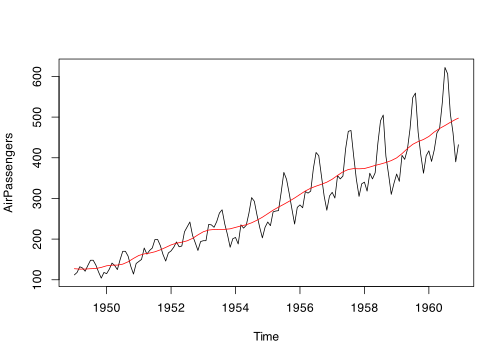
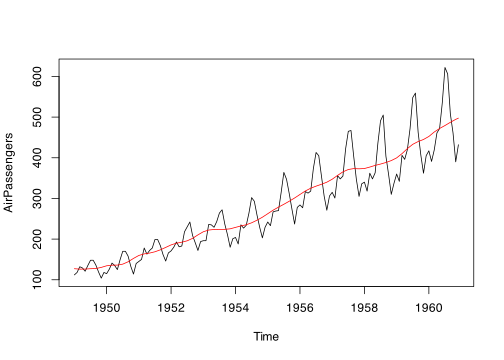
An equivalent extract_trends() function is also available for ts objects.
loess <- extract_trends(AirPassengers, methods = "stl")
#> Computing STL trend with s.window = periodic
plot.ts(AirPassengers)
lines(loess, col = "red")
Available Methods
trendseries supports many trend estimation methods. The overall goal is to support the most commonly used methods in econometrics and statistics.
| Method | Description |
|---|---|
loess | Local polynomial regression |
spline | Smoothing splines |
poly | Polynomial trends |
median | Median filter |
stl | Seasonal-trend decomposition |
ma | Simple moving average |
wma | Weighted moving average |
ewma | Exponential weighted moving average |
kalman | Kalman filter/smoother |
ucm | Unobserved components model |
kernel | Kernel smoother |
hp | Hodrick-Prescott filter |
hamilton | Hamilton regression filter |
bk | Baxter-King bandpass filter |
bn | Beveridge-Nelson decomposition |
cf | Christiano-Fitzgerald filter |
Learn More
See the vignettes for detailed examples and usage patterns: